










Breaking News
 EXCERPTS: Citigroup Inc. received approval to launch a wholly-owned securities business...
 The Crown Wants It Kept Secret: AG Asks the Federal Court to Seal Information...
 The Supreme Court Just Denied Your Constitutional Rights
 The state is trying to crush the Amish with ruinous penalties.
Top Tech News
 Modular phone promises total privacy at the flick of a switch
 Genetically Engineered War Dogs for 134 Pound Cyborg Dire Wolves Now – Later 600 Pound Wolves
 They're Quietly REPLACING Our Food With THIS… And Nobody Is Talking About It!
 Chicago Opens First "Teacher-Free" AI School as Global Push Accelerates
 Solar Panels Are Doing Something Nobody Expected
 DeLorean climbs skyward to race electric flying cars
 Atari's 800XL returns with a keyboard, cartridges and BASIC
 Bioinspired robot airdrops into remote waters via morphing wing-sail
 Anduril interceptor adapts to emerging threats via swappable stages
 I Built a Website to Expose Solar and Battery Scams


2 tesla Magnetic Shield placed at Mars Lagrange point would shield Martian atmosphere...
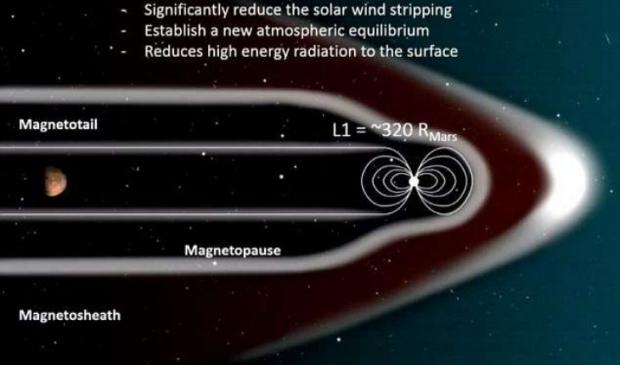
Mars atmosphere would naturally thicken over time, which lead to many new possibilities for human exploration and colonization. According to Green and his colleagues, these would include an average increase of about 4 °C (~7 °F), which would be enough to melt the carbon dioxide ice in the northern polar ice cap. This would trigger a greenhouse effect, warming the atmosphere further and causing the water ice in the polar caps to melt.
By their calculations, Green and his colleagues estimated that this could lead to 1/7th of Mars' oceans – the ones that covered it billions of years again.
"A greatly enhanced Martian atmosphere, in both pressure and temperature, that would be enough to allow significant surface liquid water would also have a number of benefits for science and human exploration in the 2040s and beyond," said Green. "Much like Earth, an enhanced atmosphere would: allow larger landed mass of equipment to the surface, shield against most cosmic and solar particle radiation, extend the ability for oxygen extraction, and provide "open air" greenhouses to exist for plant production, just to name a few."