










Breaking News
 EXCERPTS: Citigroup Inc. received approval to launch a wholly-owned securities business...
 The Crown Wants It Kept Secret: AG Asks the Federal Court to Seal Information...
 The Supreme Court Just Denied Your Constitutional Rights
 The state is trying to crush the Amish with ruinous penalties.
Top Tech News
 Modular phone promises total privacy at the flick of a switch
 Genetically Engineered War Dogs for 134 Pound Cyborg Dire Wolves Now – Later 600 Pound Wolves
 They're Quietly REPLACING Our Food With THIS… And Nobody Is Talking About It!
 Chicago Opens First "Teacher-Free" AI School as Global Push Accelerates
 Solar Panels Are Doing Something Nobody Expected
 DeLorean climbs skyward to race electric flying cars
 Atari's 800XL returns with a keyboard, cartridges and BASIC
 Bioinspired robot airdrops into remote waters via morphing wing-sail
 Anduril interceptor adapts to emerging threats via swappable stages
 I Built a Website to Expose Solar and Battery Scams


Bigelow and ULA plan expandable B330 orbital lunar space station in 2022
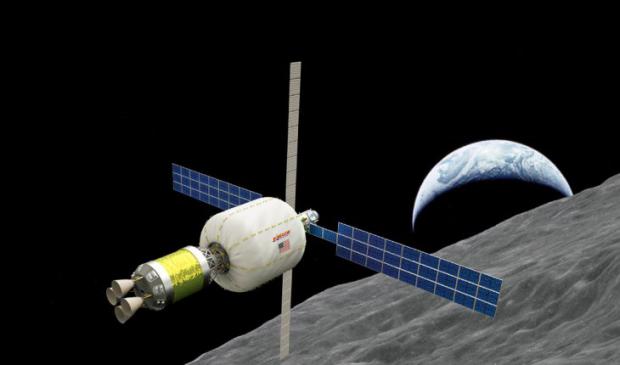
"We are excited to work with ULA on this lunar depot project," said Robert Bigelow, president of Bigelow Aerospace. "Our lunar depot plan is a strong complement to other plans intended to eventually put people on Mars. It will provide NASA and America with an exciting and financially practical success opportunity that can be accomplished in the short term. This lunar depot could be deployed easily by 2022 to support the nation's re-energized plans for returning to the Moon.
"This commercial lunar depot would provide anchorage for significant lunar business development in addition to offering NASA and other governments the Moon as a new exciting location to conduct long-term exploration and astronaut training."
The B330 would launch to Low Earth Orbit on a Vulcan 562 configuration rocket, the only commercial launch vehicle in development today with sufficient performance and a large enough payload fairing to carry the habitat. Once the B330 is in orbit, Bigelow Aerospace will outfit the habitat and demonstrate it is working properly. Once the B330 is fully operational, ULA's industry-unique distributed lift capability would be used to send the B330 to lunar orbit. Distributed lift would also utilize two more Vulcan ACES launches, each carrying 35 tons of cryogenic propellant to low Earth orbit. In LEO, all of the cryogenic propellant would be transferred to one of the Advanced Cryogenic Evolved Stage (ACES). The now full ACES would then rendezvous with the B330 and perform multiple maneuvers to deliver the B330 to its final position in Low Lunar Orbit.