










Breaking News
Trump's War In Iran Is Not Destroying Iran; It Is Destroying AMERICA
 NASA Chief: "We Just Built Antigravity Propulsion!"
 Carl Higbie (NEWSMAX) says LIVE on TV: "The Senate is supposed to vote on the Clarity Act NEXT
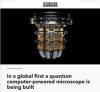 Quantum computing may soon become part of the microscope itself.
Top Tech News
Quantum computing may soon become part of the microscope itself.
 Volkswagen Just Unveiled The Most Efficient EV Ever Tested
 NASA Super Light Solar Sail Project Will Be 12-40 Times Lighter and Faster
 Space Telescope Interferometer to Image Exoplanet Continents
 Twenty-five years of "temporary": how 9/11 built a surveillance state Americans never vote
 I'll Never Buy Another WALMART Battery!
 Shoei GT-Air 3 Smart helmet drops with built-in AR for $1,500
 AI Whistleblower Tells Tucker How AI Could Kill All Humans by 2040
 You Hate Flock? Well There's More...
 Will Spiking Diesel Prices Drive Autonomous Trucking?



First 3 nanometer test chip tapeout from Cadence Designs

The tapeout project, geared toward advancing 3nm chip design, was completed using extreme ultraviolet (EUV) and 193 immersion (193i) lithography-oriented design rules and the Cadence® Innovus™ Implementation System and Genus™ Synthesis Solution. Imec utilized a common industry 64-bit CPU for the test chip with a custom 3nm standard cell library and a TRIM metal flow, where the routing pitch was reduced to 21nm. Together, Cadence and imec have enabled the 3nm implementation flow to be fully validated in preparation for next-generation design innovation.
The Cadence Innovus Implementation System is a massively parallel physical implementation system that enables engineers to deliver high-quality designs with optimal power, performance and area (PPA) targets while accelerating time to market. The Cadence Genus Synthesis Solution is a next-generation, high-capacity RTL synthesis and physical synthesis engine that addresses the latest FinFET process node requirements, improving RTL designer productivity by up to 10X.