










Breaking News
 #689: The Empire of Lies | Charles Goyette
 One Arizona storm; 15 rain totes
 Teach AI Good Morality
 Guilfoyle Resigns at Trump's Request Following Credit Card Scandal
Top Tech News
 I Built a Website to Expose Solar and Battery Scams
 Whistleblower Issues Dire Warning: Rogue AI, Hacking Nuclear Programs...
 Multi-material insulation delivers up to 10,000 x the stiffness
 Anduril's plan to save US sub edge from China's undersea surge
 Researchers Develop AI 'Mind-Reading' Tool That Reconstructs What Your Eyes See
 Video: Dexterous robot hand learns the delicate art of silk embroidery
 The computer that can read your mind:
 Seven apps. One craft
 SHOCK CASE REPORT: Advanced Alzheimer's Patient Regains Speech, Memory, Mobility...
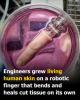 Most artificial limbs rely on silicone or plastic to mimic human hands.



Theoretical progress on producing and storing several grams of antimatter per year
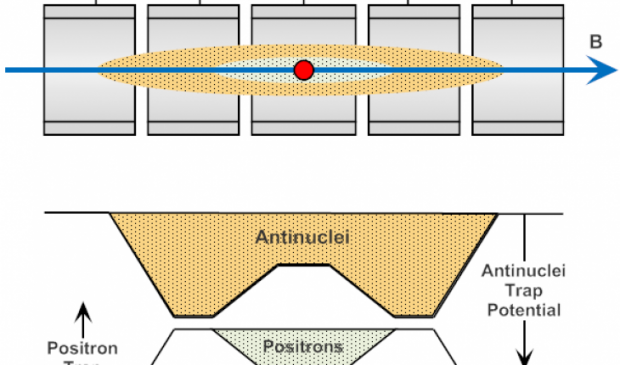
The current belief is that freezing it as anti-lithium or anti-carbon would make it easier to handle. Gerald Jackson has made progress on the steps to produce anti-lithium and anti-carbon and to store it.
Before entering the private sector in the autumn of 2000, Dr. Gerald Jackson was an accelerator physicist at the Fermi National Accelerator Laboratory for 14 years. He received his doctorate in Physics from Cornell University in 1987. His thesis committee included Nobel Prize winner Kenneth Wilson, and his thesis advisor was one of a long line of influential physicists, including Robert Wilson (Manhattan Project and Founder of the Fermi National Accelerator Laboratory) and Ernest Lawrence (Nobel Prize winner and inventor of the cyclotron).