










Breaking News
 Amazon Boeing Plane Bursts Into Flames After it Overshoots Runway at Miami International Airpot
 Trump grants clemency to 30 people, White House pardon czar says
 Bessent: "CUT THE SNAKE'S HEAD OFF"--But Who is the Real Target?
 Special LIVE Saturday Show: Could The Gov Seize XRP After Chilling FDIC Admission? Gas Prices...
Top Tech News
 Floating data center would provide water and electricity to 32,000 homes
 OpenAI Cuts Off Elon's Cursor, Humanity's First Star Probe, and Trump's Nuclear Mars Shi
 Eating pollution? Plastic-to-cookie technology raises safety, environmental concerns
 Ford's $30,000 Fathom EV Truck Appears More Conventional Than Expected
 Berlin-based artist Simon Weckert explored that idea with Digital Camouflage...
 Tether expands tokenization business into Saudi Arabia, starting with real estate
 Ukraine is facing a new problem in its war with Russia:
 It charges more than it discharges while driving
 Dataminr AI tech to go live on NATO Maven system: CEO
  The Most Dangerous Interview Ever Recorded? PART 2


Could the Airfish-8 finally get the Wing In Ground Effect Vehicle up and running?
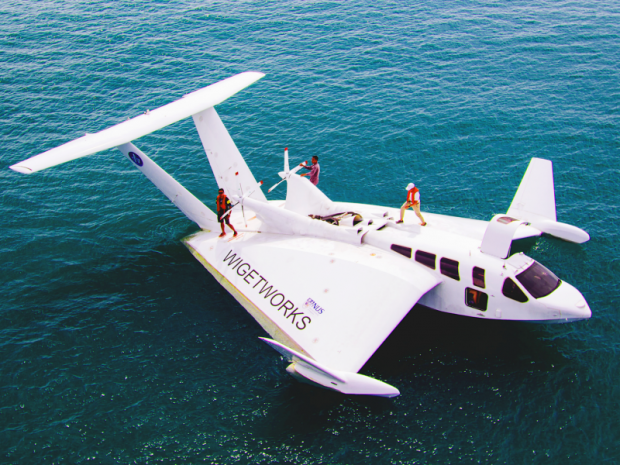
The wing-in-ground effect is well understood at this point: when an aircraft is close to the ground, it operates significantly more efficiently than it does higher up. The additional air pressure underneath the aircraft at altitudes below half the wingspan adds extra lift, and you also get a corresponding reduction in lift-induced drag. The ground effect increases the closer you get to the surface, peaking at an altitude around 5 percent of the wingspan, where you can get a craft operating some 2.3 times as efficiently as if does in free air.
Numerous attempts have been made to capitalize on this effect for quick, efficient transport over water, but right now, the leading players appear to be Sea Wolf Express, which plans to begin a passenger ferry service between Helsinki, Finland and Tallinn, Estonia, using a Russian-built Ground Effect Vehicle (GEV) in 2019, and Wigetworks Private Limited, operating out of Singapore.