










Breaking News
 EXCERPTS: Citigroup Inc. received approval to launch a wholly-owned securities business...
 The Crown Wants It Kept Secret: AG Asks the Federal Court to Seal Information...
 The Supreme Court Just Denied Your Constitutional Rights
 The state is trying to crush the Amish with ruinous penalties.
Top Tech News
 Modular phone promises total privacy at the flick of a switch
 Genetically Engineered War Dogs for 134 Pound Cyborg Dire Wolves Now – Later 600 Pound Wolves
 They're Quietly REPLACING Our Food With THIS… And Nobody Is Talking About It!
 Chicago Opens First "Teacher-Free" AI School as Global Push Accelerates
 Solar Panels Are Doing Something Nobody Expected
 DeLorean climbs skyward to race electric flying cars
 Atari's 800XL returns with a keyboard, cartridges and BASIC
 Bioinspired robot airdrops into remote waters via morphing wing-sail
 Anduril interceptor adapts to emerging threats via swappable stages
 I Built a Website to Expose Solar and Battery Scams


Can carbon fiber car panels double as energy storage materials?
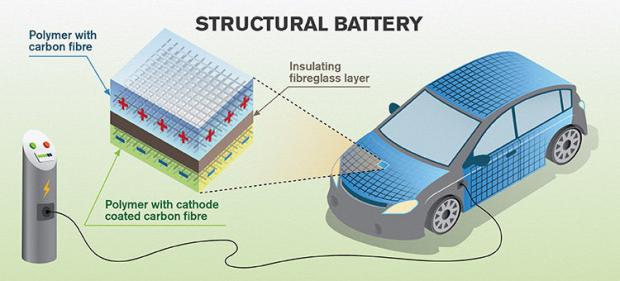
Its incredible lightness and strength has seen it take hold in everything from competitive cycling, to supercar design to cutting edge aircraft. But could it also play a role in energy storage? One team of scientists has been exploring the possibilities, and say that carefully engineered forms of the material do indeed boast the necessary electrochemical properties, raising some interesting possibilities for weight-saving vehicle design.
The research was carried out at Sweden's Chalmers University of Technology and started with a pretty simple premise. Carbon fiber has already been shown to have potential as an electrode material in experimental batteries, while its mechanical properties are well established, so can these two attributes be combined in the one multipurpose material?