










Breaking News
 FIGHT CLUB Was a Joke Nobody Got
 SCOTUSGATE | PART IX: The Sotomayor Ledger
 U.S. Senate ratifies the Louisiana Purchase
 Supreme Court to hear arguments on 160-year-ban on home distilleries
Top Tech News
 Bioinspired robot airdrops into remote waters via morphing wing-sail
 Anduril interceptor adapts to emerging threats via swappable stages
 I Built a Website to Expose Solar and Battery Scams
 Whistleblower Issues Dire Warning: Rogue AI, Hacking Nuclear Programs...
 Multi-material insulation delivers up to 10,000 x the stiffness
 Anduril's plan to save US sub edge from China's undersea surge
 Researchers Develop AI 'Mind-Reading' Tool That Reconstructs What Your Eyes See
 Video: Dexterous robot hand learns the delicate art of silk embroidery
 The computer that can read your mind:
  Seven apps. One craft


UPDATE: Remember How Walmart Employees LOVED Their Robot Coworkers?
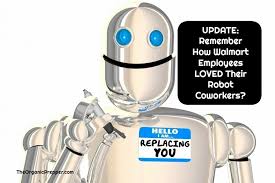
A couple of months ago, we reported that Walmart was beginning to use robots to carry out mundane tasks like mopping its floors and tracking inventory.
Last year, the company raised wages and is using the robots in more than 1,500 of its stores in an effort to cut down on labor costs. Robots "stealing" jobs should not surprise anyone – as more people demand a higher minimum wage, more jobs will be eliminated or replaced by machines…but I digress.
Back in April, Zero Hedge reported:
Walmart, which is the largest employer in the US, said at least 300 stores will introduce machines that scan shelves for out-of-stock products. Meanwhile, so-called "autonomous floor scrubbers" will be deployed in 1,500 stores, and conveyor belts that automatically scan and sort products as they are loaded off of trucks will more than double to 1,200. Another 900 stores will install 16-foot-high towers that will allow customers to pick up their online grocery orders without interacting with humans. (source)
Walmart's claim that employees like their new robot colleagues isn't entirely true.
Also back in April, we reported that the higher-ups at the company claimed employees are happy about their AI coworkers:
Naturally, the mega-retailer wants us to believe that robots taking over certain tasks in their stores is a good thing – a change that will allegedly benefit their human employees. "With automation, we are able to take away some of the tasks that associates don't enjoy doing," Mark Propes, senior director of central operations for Walmart US, told The Wall Street Journal. "At the same time, we continue to open up new jobs in other things in the store."
In a press release titled #SquadGoals: How Automated Assistants are Helping Us Work Smarter, Walmart refers to the robots as "smart assistants" and claims that the response from associates has been "overwhelmingly positive" so far:
"Our associates immediately understood the opportunity for the new technology to free them up from focusing on tasks that are repeatable, predictable and manual," said John Crecelius, senior vice president of Central Operations for Walmart U.S. "It allows them time to focus more on selling merchandise and serving customers, which they tell us have always been the most exciting parts of working in retail."
Yeah, about that "overwhelmingly positive" response from human Walmart employees…it looks like they aren't so fond of their AI associates after all.
According to a new report from The Washington Post, many Walmart employees are finding the robots difficult to deal with:
To Walmart executives, the Auto-C self-driving floor scrubber is the future of retail automation — a multimillion-dollar bet that advanced robots will optimize operations, cut costs and revolutionize the American superstore.
But to the workers of Walmart Supercenter No. 937 in Marietta, Ga., the machine has a different label: "Freddy," named for a janitor the store let go shortly before the Auto-C rolled to life.
Freddy's career at the store has gotten off to a rocky start. Workers there said it has suffered nervous breakdowns, needed regular retraining sessions and taken weird detours from its programmed rounds.
Shoppers are not quite sure how to interact with Freddy, either. Evan Tanner, who works there, recalled the night he says a man fell asleep on top of the machine as it whirred obediently down a toy aisle.