










Breaking News
 Johnny Depp is the swashbuckling star they couldn't cancel! Eight years after Disney dropped...
 Hero father Kaylub Giamanco, who brought down Oregon school shooter, happened to be driving...
 Mount St Helens triggers aviation warnings after winds whip up old volcanic ash into the skies
 Netflix bosses 'freaking out' over poor test screenings for director Greta Gerwig's $280
Top Tech News
 I Built a Website to Expose Solar and Battery Scams
 Whistleblower Issues Dire Warning: Rogue AI, Hacking Nuclear Programs...
 Multi-material insulation delivers up to 10,000 x the stiffness
 Anduril's plan to save US sub edge from China's undersea surge
 Researchers Develop AI 'Mind-Reading' Tool That Reconstructs What Your Eyes See
 Video: Dexterous robot hand learns the delicate art of silk embroidery
 The computer that can read your mind:
 Seven apps. One craft
 SHOCK CASE REPORT: Advanced Alzheimer's Patient Regains Speech, Memory, Mobility...
 Most artificial limbs rely on silicone or plastic to mimic human hands.



Watch SpaceX boat catch falling payload fairing in giant net (video)
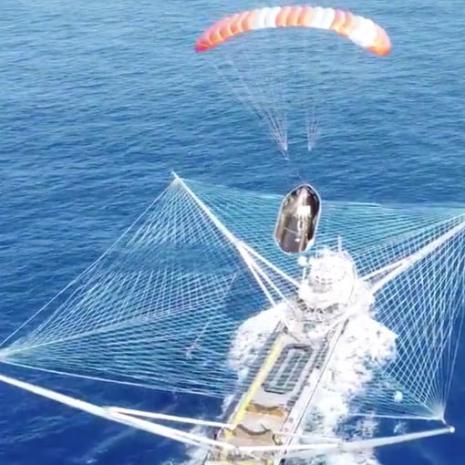
SpaceX just plucked another payload fairing out of the sky, and you can see video of the dramatic cosmic catch.
The net-equipped SpaceX boat GO Ms. Tree snagged half of a falling payload fairing Tuesday (Aug. 18), shortly after a two-stage Falcon 9 rocket launched 58 Starlink internet satellites and three Earth-observation spacecraft into orbit.
Payload fairings are the shrouds that protect satellites during launch. SpaceX fairings come in two pieces, both of which come back to Earth under parachutes in a guided fashion, thanks to small thrusters. Such tech aids recovery and reuse of the fairings, which cost about $6 million each, SpaceX founder and CEO Elon Musk has said.
GO Ms. Tree and its sister ship, GO Ms. Chief, are part of this picture as well. Seawater is extremely corrosive, so snatching fairing halves out of the sky makes refurbishment easier, Musk has said. The ships have snagged a handful of fairings to date, including a double catch during the launch of a South Korean military satellite last month. (Ocean splashdowns don't preclude reuse, however; SpaceX has reflown fairings that it fished out of the water.)
GO Ms. Chief pulled one fairing half out of the Atlantic Ocean today. But GO Ms. Tree caught the other one, a success captured by a camera-equipped drone. Musk posted that footage on Twitter Tuesday, scoring the 43-second video with some playfully incongruous lounge music.
Aloha, welcome back from space ?'? pic.twitter.com/xWPN09Wtaw
— Elon Musk (@elonmusk) August 18, 2020