










Breaking News
France's Immigration Party Coming to America: Faster Than You Think
A3Podcast 8 - Our Enemy, the State; Publishing and Accessing An IPFS Website; and more...
 Tuesday War Room LIVE – 'Let Us In': 1 Million Migrants Torch Italy As Trump Warns...
 The Fall of Saudi Arabia?
Top Tech News
 Solar Panels Are Doing Something Nobody Expected
 DeLorean climbs skyward to race electric flying cars
 Atari's 800XL returns with a keyboard, cartridges and BASIC
 Bioinspired robot airdrops into remote waters via morphing wing-sail
 Anduril interceptor adapts to emerging threats via swappable stages
 I Built a Website to Expose Solar and Battery Scams
 Whistleblower Issues Dire Warning: Rogue AI, Hacking Nuclear Programs...
 Multi-material insulation delivers up to 10,000 x the stiffness
 Anduril's plan to save US sub edge from China's undersea surge
 Researchers Develop AI 'Mind-Reading' Tool That Reconstructs What Your Eyes See



Cellular Imaging from Phonon Imaging on a Fiber Probe
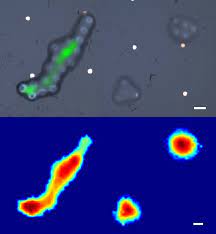
The new technology produces microscopic and nanoscopic resolution images that will one day help clinicians to examine cells inhabiting hard-to-reach parts of the body, such as the gastrointestinal tract, and offer more effective diagnoses for diseases ranging from gastric cancer to bacterial meningitis.
Nature Light Science and Applications- Phonon imaging in 3D with a fibre probe
Abstract
We show for the first time that a single ultrasonic imaging fibre is capable of simultaneously accessing 3D spatial information and mechanical properties from microscopic objects. The novel measurement system consists of two ultrafast lasers that excite and detect high-frequency ultrasound from a nano-transducer that was fabricated onto the tip of a single-mode optical fibre. A signal processing technique was also developed to extract nanometric in-depth spatial measurements from GHz frequency acoustic waves, while still allowing Brillouin spectroscopy in the frequency domain. Label-free and non-contact imaging performance was demonstrated on various polymer microstructures. This singular device is equipped with optical lateral resolution, 2.5 μm, and a depth-profiling precision of 45 nm provided by acoustics. The endoscopic potential for this device is exhibited by extrapolating the single fibre to tens of thousands of fibres in an imaging bundle. Such a device catalyses future phonon endomicroscopy technology that brings the prospect of label-free in vivo histology within reach.