










Breaking News
 The TERRIFYING Reason Peter Thiel Escaped the US
 Professor Jiang Breaks Down the Greater Israel Project
 Edward Snowden on Palestine and Sam Altman
 Palantir. IT'S WORSE Than You Think
Top Tech News
 Solar Panels Are Doing Something Nobody Expected
 DeLorean climbs skyward to race electric flying cars
 Atari's 800XL returns with a keyboard, cartridges and BASIC
 Bioinspired robot airdrops into remote waters via morphing wing-sail
 Anduril interceptor adapts to emerging threats via swappable stages
 I Built a Website to Expose Solar and Battery Scams
 Whistleblower Issues Dire Warning: Rogue AI, Hacking Nuclear Programs...
 Multi-material insulation delivers up to 10,000 x the stiffness
 Anduril's plan to save US sub edge from China's undersea surge
 Researchers Develop AI 'Mind-Reading' Tool That Reconstructs What Your Eyes See



Mouse embryo is grown in a lab from stem cells and features beating heart...
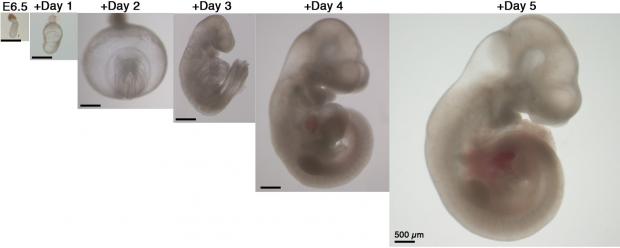
A mouse embryo developed from stems cells has a beating heart and is starting to develop muscles, a gut and nervous system while it grows inside a lab at the University of Virginia.
Scientists sparked development of the cells by weaving the different types together, allowing it to become 'the first in vitro model of a mammalian embryo with so many tissues to be built from stem cells,' the team shared in a press release.
This is also the first version complete with a notochord, which is a cartilaginous skeletal rod supporting the body in all embryos and 'is a definite trait of vertebrate animals,' according to the researchers.
The team hopes the breakthrough will assist researchers with understanding mammalian development, battle diseases, create new drugs and grow tissues and organs for human transplants.
Christine Thisse, Ph.D., of UVA's Department of Cell Biology, said in a statement: 'We found a way to instruct aggregates of stem cells to initiate embryonic development.
'In response to this controlled instruction, the aggregates develop into embryo-like entities in a process that recapitulate the embryonic steps one-by-one.
'What is amazing is that we can get the variety of tissues that are present in an authentic mouse embryo.'
The use of stem cells has opened up a new world of science, allowing experts to use the special cells to create other cells with different functions.