










Breaking News
 U.S. Strengths and Weaknesses in Production
 Washington Lost the Equivalent of Two Apples. Did Anyone Notice?
 The Light at The End of the Tunnel - It's Not All Doom & Gloom
 Iran has published a naive letter to the American People
Top Tech News
 A laser just photographed objects through six feet of concrete
 Elon Musk's Next-Gen Motor Destroy Entire EV Industry
 China's disputed satellite refueling heralds new space war era
 BYD Will Put Solid-State Batteries In An EV Next Year: Executive
 FDA-cleared exoskeleton puts spinal-cord patients back on their feet
 Your Robotic Vacuum Is Watching You -- Could It Someday Testify Against You in Court?
 Why Unigrid's Sodium-Ion Batteries Are the Game-Changer for Off-Grid Energy Storage
 This Battery On Wheels Makes Any Diesel Truck Electric In 5 Minutes
 Mass-Production of AI Infrastructure – Speed Up by 10X
 3D-printed Martian mud homes look critical for life beyond Earth



New John Deere Tractors Plow Day and Night With No One in the Cab:
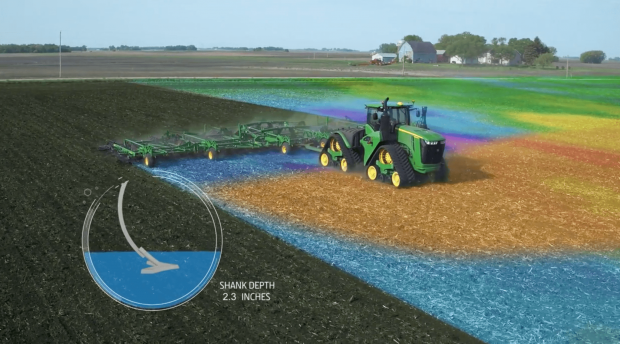
John Deere, the world's largest farming implements producer, just unveiled a self-driving tractor to plow America's acreage by day or night without a driver.
Unveiled at the Consumer Technology Association (CES) convention 2022 in Las Vegas, John Deere have said that the 8R autonomous tractor will "enable farmers to place seeds, spread nutrients, and harvest their crops without having to touch the steering wheel."
It's a technological revolution that's been creeping up on us all, with the introduction first of lane assist, auto parallel parking, and then of the self-driving modes on various makers like Tesla.
For a tractor, there are no intersections, pedestrians, tall buildings to block GPS signals, traffic, or balls rolling into the road, and so an autonomous vehicle has much less to contend with.
As large and segmented as America's hinterlands are, farmers often have to plough, cultivate, seed, spray, and harvest many thousands of acres on separate paddocks miles away from each other. With an autonomous tractor, they can plow one field robotically, and another the old-fashioned way, giving farmers more time to do more sensitive work.
"The driverless tractors are equipped with six pairs of cameras that work like human eyes and can provide a 360-degree image," AP reports. "When filtered through computer algorithms, the tractor is able to determine where it is in the field and will abruptly stop if there is anything unfamiliar in its path."
Given changing climatic conditions, the opportunity to double or triple the labor inputs to capitalize on short periods of ideal temperature and moisture can mean thousands of dollars more per acre for farmers.