










Breaking News
 Russia Hits Ukraine Power Plant Despite "Energy Ceasefire"
 Multi-material insulation delivers up to 10,000 x the stiffness
 Trump Just Started The Debt Spiral
 Look up...
Top Tech News
 Anduril's plan to save US sub edge from China's undersea surge
 Researchers Develop AI 'Mind-Reading' Tool That Reconstructs What Your Eyes See
 Video: Dexterous robot hand learns the delicate art of silk embroidery
 The computer that can read your mind:
 Seven apps. One craft
 SHOCK CASE REPORT: Advanced Alzheimer's Patient Regains Speech, Memory, Mobility...
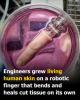 Most artificial limbs rely on silicone or plastic to mimic human hands.
 Flying cell tower beams phone signal to Japan from 10 miles up
 Chinese Commercial Reactor Achieves Nuclear Fusion with Clean Hydrogen-Boron Fuel
 Palmer Luckey: Autonomous Weapons Are Ancient and Why Anduril Won't Build Humanoids | EP #295



Is the cure for blindness here? As a US veteran receives the world's first eye transplant...
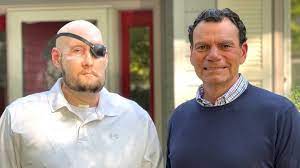
Aaron James, 46, miraculously survived a 7,200-volt electric shock when his face touched high-voltage wiring in 2021.
The accident left him with severe injuries to his left arm, nose, lips, front teeth, left cheek, and chin. His eye also had to be removed.
But in May, a team of 140 medics in New York City performed a 21-hour eye and partial face transplant, the first surgery of its kind.
Up until this point, transplants had been thought impossible due to the complex network of nerves and blood vessels connecting the eye to the brain.
Doctors have now said it's possible the father of one will be able to see out of the transplanted eye eventually.
Experts told MailOnline it is an 'exciting development but warned it is 'too early to say' whether the procedure marks a step towards curing blindness.
What causes blindness?
Injuries, infections and many medical conditions can cause blindness, which can vary from severe sight impairment to total blindness.
Globally, at least 2.2billion people have a vision impairment or blindness, according to the World Health Organization (WHO).