










Breaking News
 Welfare Is Immoral in Any Country
 Hair-Raising Case: White Baltimore Arts Executive Fired For Wearing Cornrows
 The Honda NSX rises ... with more horsepower and carbon fiber
 'Hypocrite' Hillary Clinton is slammed for her comments on Fort Hood killer's...
Top Tech News
 Seven apps. One craft
 SHOCK CASE REPORT: Advanced Alzheimer's Patient Regains Speech, Memory, Mobility...
 Most artificial limbs rely on silicone or plastic to mimic human hands.
 Flying cell tower beams phone signal to Japan from 10 miles up
 Chinese Commercial Reactor Achieves Nuclear Fusion with Clean Hydrogen-Boron Fuel
 Med Beds Just Took a MASSIVE Step Forward, Healing People in Days!
 Palmer Luckey: Autonomous Weapons Are Ancient and Why Anduril Won't Build Humanoids | EP #295
 A laser just photographed objects through six feet of concrete
 Elon Musk's Next-Gen Motor Destroy Entire EV Industry
 China's disputed satellite refueling heralds new space war era



Biokabin: our modular eco-home to snap & build in backyard, Nature
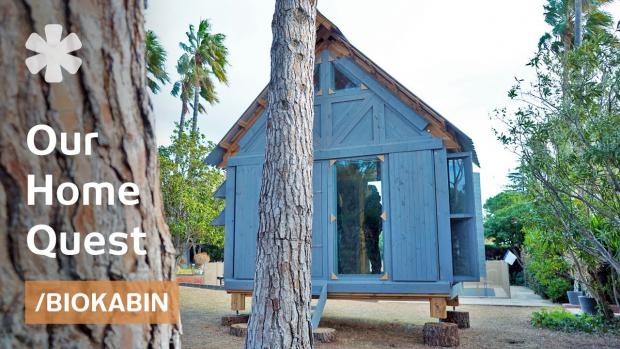
At first we didn't know everything about it, but we were sure that house needed to belong to the place, to be healthy and to age well. But the real challenge was: could we build it ourselves without fancy tools, and to create a design that could work for other people as well?
Over the past couple years, with the help of architect and carpenter friends, we designed and built a modular home that can be as small as 100 square feet (one module) to as large as you'd like by simply adding modules. The components are cut in a factory and can be assembled with just a few people, and a wrench and a ladder (no need for a crane).
Living in small apartments and seeing very compact dwellings we also realized that it's not the layout, but the 3D-space that matters, so we wanted to design something high to allow for two-story setups. Style and quality were important, so we used our collective experience of Scandinavian, Mediterranean, and California design.
Soon we will be building the first three-module Biokabin Living as an ADU in our California backyard, but we would love to see it in other parts of California or Southern Europe (as a start). We can only produce ten the first year because we want to be able to focus on each one.