










Breaking News
 2026-10-15 -- Ernest Hancock and Dr Phranq Tamburri (Trump Report) MP3&4
 Semafor: I Cost the GOP a Senate Seat. Now I'm Doing It to 8 More.
 Episode 498: VACCINE INJURY VINDICATION, CLIMATE SKEPTICS GAIN GROUND...
 "The President is Busy Dismantling the Deep State!" – Press Secretary
Top Tech News
 I Built a Website to Expose Solar and Battery Scams
 Whistleblower Issues Dire Warning: Rogue AI, Hacking Nuclear Programs...
 Multi-material insulation delivers up to 10,000 x the stiffness
 Anduril's plan to save US sub edge from China's undersea surge
 Researchers Develop AI 'Mind-Reading' Tool That Reconstructs What Your Eyes See
 Video: Dexterous robot hand learns the delicate art of silk embroidery
 The computer that can read your mind:
 Seven apps. One craft
 SHOCK CASE REPORT: Advanced Alzheimer's Patient Regains Speech, Memory, Mobility...
 Most artificial limbs rely on silicone or plastic to mimic human hands.



This Bonkers 656-Foot 'AirYacht' Concept Can Transport 40 Guests Around the World
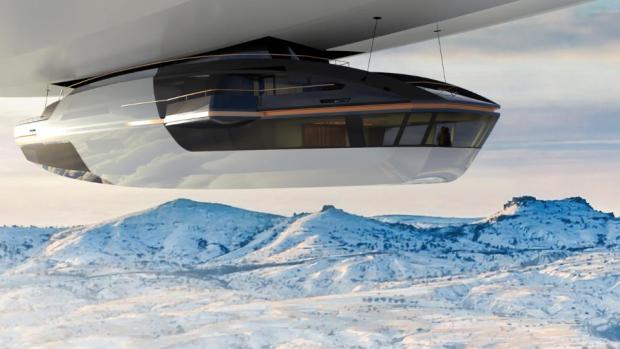
The 656-foot-long AirYacht is moving closer to reality, but its latest iteration might force the designers to change its name. Instead of a two-part structure that includes a 197-foot superyacht that releases from the upper blimp portion, the latest version will have a nondetachable lounge to increase its weight capacity and accommodate more passengers.
The AirYacht will now stay exclusively in the air, says CEO Guillaume Hoddé, who cofounded the Swiss company with fellow engineer Matthieu Ozanne. Jettisoning the boat allows more flexibility to accommodate larger groups and weight capacity, with the ability to make longer cruising trips to enhance the experience. "We founded the company with a dream of living in the air," Hoddé told Robb Report. "At 500 feet, you can see, feel, and smell the environment with almost limitless accessibility. That is different from any other mode of travel."
The redesigned lounge will have about 8,600 square feet of livable space that can accommodate 10 to 40 guests, depending on the configuration. The company is looking to sell its airships to different operators around the world, who can then specify the interior layouts.
The company has fabricated prototypes for many subsystems, says Hoddé, with the first full-scale prototype serving as the first airship. He declined to specify when the full-scale version would be ready, but initial flight tests are planned for 2026, and after modifications, it should be commercially available two years later. It will be operated with hybrid propulsion (with the goal of running on emissions-free hydrogen power by 2030) capable of a maximum altitude of about 10,000 feet, with the capacity to remain fixed in one place so guests can enjoy prolonged views of specific areas. It is designed to remain autonomous for a week but a top speed of 50 knots means it can cover long distances.
Hoddé envisions the AirYacht cruising above all types of terrain, from polar regions to African savannahs to beautiful, verdant areas of France. "Imagine taking off from Geneva, doing aerial sightseeing over Lake Annecy, and Montblanc Valley in the French Alps, and then flying over 22 castles along the Loire," says Hoddé.