










Breaking News
 Portable 1MW Kaleidos Microreactor Secures Critical Nuclear Fuel Deal Through 2030s
 Family Structure Determines Kids' Success In School More Than Race Or Income, Researchers Say
 Turkey & Israel On Brink Of Military Clash After Netanyahu Ordered Strikes On Syrian Airbase
 Georgia Refuses To Adopt EU Sanctions On Iran Citing 'National Interests'
Top Tech News
 High-voltage sodium home battery emerges as affordable rooftop solar solution
 Peter Thiel-Funded Company Anduril to Triple the Number of Autonomous Surveillance...
 China has released Origin Pilot, claimed to be the world's first open-source operating system...
 ShieldAI XBAT Drone Fighters Can Give A Fighter Drone Wing to Every US Destroyer
 Brain organoids, kept alive more than five years, matured like human brains
 Parkinson's patient's tremors VANISH within minutes of GROUNDBREAKING treatment
 Polaris injects pneumatic shifting into expedition-grade side-by-side
 NEW HOMES ARE BUILT WITH THIS AND IT'S MAKING YOU SICK
 S3E33: I Beat the Attorney General. No Lawyers. My Legal Team Was AI
 World's largest all-electric plane completes maiden flight


New video may offer glimpse of secret F-47 fighter
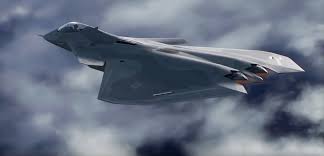
Currently in the Engineering and Manufacturing Development (EMD) phase, the F-47 is part of the US Next Generation Air Dominance (NGAD) program, with the first prototype slated to fly in 2028, though technology demonstrators have reportedly flown in secret since about 2020. If successful, the F-47 prototype will be the first of a fleet of at least 185 fighters that will replace the Lockheed Martin F-22 raptor on a one-for-one basis.
Unfortunately, that's about all that's known publicly about the F-47. The entire program is highly classified and the only glimpse the media have been given of the aircraft are a couple of cloud-shrouded concept renderings that don't really show much of anything.
All that's known for certain is that it's meant to be a long-range air dominance fighter with a top speed of about Mach 2 and a range of over 1,000 nm (1,150 miles, 1,852 km). Since it's a Gen-6 fighter, we can make certain deductions. It will be a systems-of-systems hub – that is, it will act as the central command for a squad of Loyal Wingman autonomous drones. It will also boast a very high degree of stealth against radars that would spot an F-22 or an F-35 Lightning II. In addition, it will be designed to deliver long-range missile punches instead of engaging in dogfights.
The latest video from Pratt & Whitney lasts only about 30 seconds, and its main focus isn't the F-47 itself. Instead, the Raytheon subsidiary concentrates on the XA-103 engine that is the main candidate to power it, and the all-digital design strategy that uses a digital twin to accelerate the engine's development compared to conventional methods.
Developed under the Next Generation Adaptive Propulsion (NGAP) program, the XA-103 is designed for long-range Pacific theater sorties as well as providing large amounts of surplus power for next-generation sensors and directed energy weapons. It also has advanced thermal management systems, which is a top-shelf way of describing a special airflow system that acts as a heat sink, cooling the fighter's internal systems and masking its heat signature.
Like the F-47 itself, not a lot of details are known, but the XA-103 is expected to increase the range of the F-47 by 25% and generate 10% more thrust compared to the F-35.
However, what's turning heads is the few seconds halfway through the video (embedded below), which allegedly show the F-47 in all its glory.
Or do they?
The footage may reveal that the F-47 has a high cockpit, a heavily modified delta wing, and a tailless configuration. It may also show a shovel nose, canards, and some fairly aggressive stealth features on the engine outlets.
Or it may not.