










Breaking News
 This is unbelievable
  MASSIVE WIPEOUT IN KOREAN MARKETS
 EXCERPTS: Citigroup Inc. received approval to launch a wholly-owned securities business...
 At least 10 prominent athletes DIED UNEXPECTEDLY or were struck by anomalous medical...
Top Tech News
 Genetically Engineered War Dogs for 134 Pound Cyborg Dire Wolves Now – Later 600 Pound Wolves
 They're Quietly REPLACING Our Food With THIS… And Nobody Is Talking About It!
 Chicago Opens First "Teacher-Free" AI School as Global Push Accelerates
 Solar Panels Are Doing Something Nobody Expected
 DeLorean climbs skyward to race electric flying cars
 Atari's 800XL returns with a keyboard, cartridges and BASIC
 Bioinspired robot airdrops into remote waters via morphing wing-sail
 Anduril interceptor adapts to emerging threats via swappable stages
 I Built a Website to Expose Solar and Battery Scams
 Whistleblower Issues Dire Warning: Rogue AI, Hacking Nuclear Programs...



3D-printable concrete alternative hardens in three days, not four weeks
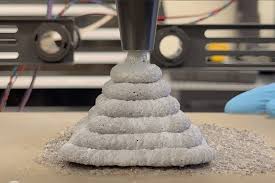
Concrete consists of three parts: water, an aggregate such as sand or gravel, and a cement which binds everything together. The cement is the part that typically takes about a month to cure after being poured. And a slow curing time isn't cement's only problem.
Traditional Portland-style cement is made by grinding up limestone and other raw materials, then heating the resulting powder to temperatures of up to 1,450 ºC (2,642 ºF). Unfortunately, the processes by which that heat is generated produce a lot of carbon dioxide.
What's more, as the heated limestone forms into cement via a process known as calcination, it releases trapped carbon dioxide as a byproduct. The combination of that CO2 and the CO2 produced in the heat-generating process is estimated to be responsible for 5% to 8% of all human-caused greenhouse gas emissions.