










Breaking News
 Facilitating Wholesale Digital Asset Settlement
 October 7th special with PROJECTPENS.org on Ben Swann's "America Now"
 Paris is on fire as rioters take over across France
 Trump Refuses Iran's Offer To Bail Out His Presidency
Top Tech News
 Bioinspired robot airdrops into remote waters via morphing wing-sail
 Anduril interceptor adapts to emerging threats via swappable stages
 I Built a Website to Expose Solar and Battery Scams
 Whistleblower Issues Dire Warning: Rogue AI, Hacking Nuclear Programs...
 Multi-material insulation delivers up to 10,000 x the stiffness
 Anduril's plan to save US sub edge from China's undersea surge
 Researchers Develop AI 'Mind-Reading' Tool That Reconstructs What Your Eyes See
 Video: Dexterous robot hand learns the delicate art of silk embroidery
 The computer that can read your mind:
  Seven apps. One craft


Tesla Just Opened Its Biggest Supercharger Station Ever--And It's Powered By Solar And Batteries
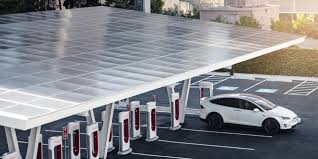
There's been a lot of handwringing about the future energy demands of electric vehicles and AI data centers. But if Tesla's latest charging station is any proof, almost anything is possible with enough solar panels and stationary batteries.
On Tuesday, Tesla announced that all Superchargers are now open for business at its largest charging station ever. The 164-stall location in Lost Hills, California, is powered by 11 megawatts of solar panels, which double as a canopy that shades the parking spots. Those panels feed 10 of the automaker's utility-scale Megapack batteries, for a total of 39 megawatt-hours of energy storage.
By comparison, a typical fast-charging location has anywhere from four to 20 stalls, with Tesla leading the pack on larger installations. Previously, a 120-stall Supercharger site in Barstow, California, was the company's largest.
"Yes, the largest Supercharger in the world is powered by the sun," said Max de Zegher, Tesla's director of charging across several regions, in an X post.
The station off of I-5 may set a new benchmark for fully sustainable EV charging. It's also a strong testament to Tesla's vertical integration. Elon Musk's company develops not just electric cars but charging stations too, plus the energy systems that power them. That sort of convergence is a trend we'll probably see more of across the industry, as other automakers emulate Tesla with ventures into public charging, home energy systems and stationary battery storage.
Using solar and battery storage helped Tesla deploy the humongous station faster than it could've with a typical grid connection, de Zegher said. It can take several months or years for utilities to make the necessary upgrades and get a new charging station energized. That's one of the primary impediments to a quicker rollout of DC fast chargers in America.
"Our forecasts showed a severe charging infrastructure deficit along the San Francisco - Los Angeles corridor for the 2025 holidays and beyond, creating extreme urgency to bring more Superchargers online. Utility grid connections wouldn't arrive in time," he said. "With our own solar generation and Megapacks, we have control of our timeline, delivering the needed capacity in under 8 months from construction start."
Tesla opened the first 84 stalls in early July, eight months after starting construction. That means the entire site took about a year.