










Breaking News
 Rising Prices and Falling Values--Inflation and Social Decay
 The non-Zionist Israeli Population Could Save the Day
 AfD Launches 'Knife App' As Berlin Violence Surges
 Oil Prices EXPLODE After Trump Signals That US Is Moving To Wartime Economy
Top Tech News
 DARPA O-Circuit program wants drones that can smell danger...
 Practical Smell-O-Vision could soon be coming to a VR headset near you
 ICYMI - RAI introduces its new prototype "Roadrunner," a 33 lb bipedal wheeled robot.
 Pulsar Fusion Ignites Plasma in Nuclear Rocket Test
 Details of the NASA Moonbase Plans Include a Fifteen Ton Lunar Rover
 THIS is the Biggest Thing Since CGI
 BACK TO THE MOON: Crewed Lunar Mission Artemis II Confirmed for Wednesday...
 The Secret Spy Tech Inside Every Credit Card
 Red light therapy boosts retinal health in early macular degeneration
 Hydrogen-powered business jet edges closer to certification


The Great Automotive Deregulation?
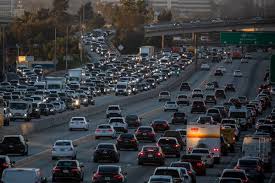
Now, just months later, in what EPA Administrator Lee Zeldin is billing "the single largest deregulatory action in the history of the United States," the Donald Trump administration has killed the "endangerment finding" which allowed the EPA to regulate "greenhouse gasses" as a threat to human health due to the risk of "climate change." On top of this, the administration has reduced MPG requirements while Congress has removed penalties entirely, making those a "recommendation," not a requirement. A New York Times article panicking about this modest bit of freedom, titled "With Latest Rollback, the U.S. Essentially Has No Clean-Car Rules" provides fascinating, and frankly chilling, insight into the minds of regulators and "experts."
The common understanding of regulations is that since businesses maximize profit at the expense of other things which impact workers, consumers, and the general public, it is necessary to regulate their activity in the name of the public good. This is thought to have some direct economic cost to businesses and consumers, which is said to be either worth paying due to it saving lives or is made up by other savings such as, for example, the various economic costs of polluted air, like increased healthcare costs. Another reason is to safeguard access to resources, such as reducing oil consumption, which was the big thing when cars began to be heavily regulated in this regard in the 1970s, but which is no longer relevant in a world where the United States is a net oil exporter. Nevertheless "conservation" being its own good has been drilled into the heads of much of the public, so "reducing gas use" is still seen by many as necessary or desirable. Obviously, cars consume fuel and pollute the air, and can be regulated to do less of those things, though how well that works and if it is worth what it costs is a more complex topic.
However, over time environmentalists and regulators became increasingly against oil itself, and in 2009 the EPA began to regulate cars for "climate change," as opposed to just pollutants which directly impact human health when breathed in, like nitrogen oxides (the emissions of which are still EPA regulated, though those standards may also be relaxed). Increasingly, politicians wanted to switch to electric-only cars, with the Joe Biden administration setting 2034 standards of around 50 MPG for cars and California trying to phase out new gas cars by 2035. As per the Times, the "endangerment finding" had allowed the EPA to push these standards more aggressively than fuel-economy rules alone could, "Setting targets so low they would eventually have become virtually impossible for gasoline engines to meet," which they see as a good thing. The Trump administration has only rolled the MPG numbers back to 34.5 MPG for a full car lineup, which the article claims would lower them to "largely irrelevant levels," though my 2002 Mazda Protege5—a small economy car—gets 24 MPG combined, so in fact this would still represent aggressive MPG regulation, if not for the fact that there is now a $0 fine for violations.
Where the "experts" move into unusual territory is by arguing that this de-regulation will hurt the auto industry, its future, and its ability to compete globally. It is one thing to think that subsidies and protective tariffs and the like are necessary for that purpose, but I know of no economic theory which posits that government regulations—universally considered to cost businesses money—help businesses remain profitable and globally competitive. Nevertheless, this appears to be what this entire regulatory cabal believes. One Margo T. Oge, the top EPA vehicle regulator under three presidents, says that if deregulation encourages the production of gas cars while China moves towards electric, "Our automakers are not going to survive." Anne L. Kelly, from an advocacy group called Ceres, which works with businesses on their sustainability plans, lamented the risk of fragmented regulation across fifty states, and said "There is no world in which this is helpful for the auto industry," as if Montana will force states to sell lower MPG vehicles. Meanwhile, unnamed "experts" said that any move towards "gas guzzlers" that can't be sold in Europe or China could further "isolate" the U.S. market and "cede the future of automotive technology to Chinese electric vehicle giants like BYD." One would imagine that automotive companies can simply decide if it is worth competing for those markets.