










Breaking News
France's Immigration Party Coming to America: Faster Than You Think
A3Podcast 8 - Our Enemy, the State; Publishing and Accessing An IPFS Website; and more...
 Tuesday War Room LIVE – 'Let Us In': 1 Million Migrants Torch Italy As Trump Warns...
 The Fall of Saudi Arabia?
Top Tech News
 Solar Panels Are Doing Something Nobody Expected
 DeLorean climbs skyward to race electric flying cars
 Atari's 800XL returns with a keyboard, cartridges and BASIC
 Bioinspired robot airdrops into remote waters via morphing wing-sail
 Anduril interceptor adapts to emerging threats via swappable stages
 I Built a Website to Expose Solar and Battery Scams
 Whistleblower Issues Dire Warning: Rogue AI, Hacking Nuclear Programs...
 Multi-material insulation delivers up to 10,000 x the stiffness
 Anduril's plan to save US sub edge from China's undersea surge
 Researchers Develop AI 'Mind-Reading' Tool That Reconstructs What Your Eyes See



FARMERS CUT. AI EXPANDED. Ya'll might wanna pay attention to this one" - Texas Cotton Farm
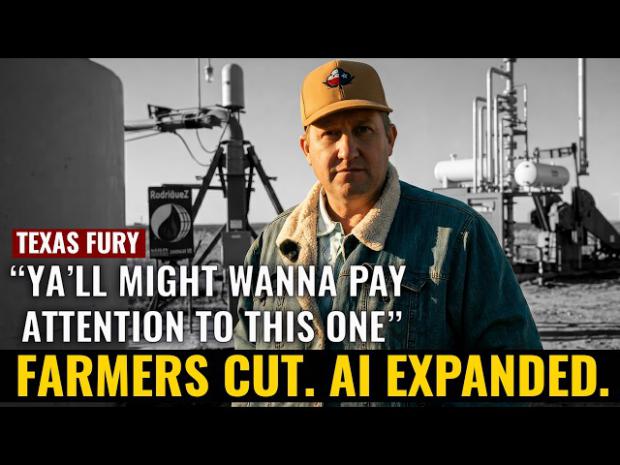
Kansas Cuts Farmers 20%. Texas Signs an AI Water Deal. Same Aquifer.
Two states.
One groundwater source.
Two completely different futures.
Kansas is ordering farmers to cut irrigation by 20% to slow depletion of the Ogallala Aquifer.
Meanwhile, in Texas, long-term water contracts are being signed to supply AI data centers — infrastructure designed to power the digital economy.
Same aquifer.
Different priorities.
This isn't a story about drought panic.
It's a story about allocation.
As artificial intelligence expands, so does its physical footprint — data centers require enormous volumes of water for cooling. At the same time, agricultural producers across the High Plains are being asked to scale back to preserve long-term supply.
So the question becomes:
Who decides where the water goes?
In this episode of The Rural Shift, we examine:
The Ogallala Aquifer's depletion trajectory
State-level conservation mandates in Kansas
Texas water contracts tied to AI infrastructure
The growing collision between digital expansion and food production
What this means for long-term rural economic stability
This is not anti-technology.
It is not anti-agriculture.
It's about structural prioritization.
When scarcity meets policy, someone absorbs the cost.
And increasingly, rural America feels it first.