










Breaking News
 Iran signals re-closure of Hormuz as it rejects uranium transfer abroad
 Goodbye leather bondage gear, hello traditional nuclear family…
 10 Essential Barter Items When the Grid Goes Dark
 The Number of Dead Iranian Protesters Keeps Changing Because It's a Fictional Story
Top Tech News
 Researchers Turn Car Battery Acid and Plastic Waste into Clean Hydrogen and New Plastic
 'Spin-flip' system pushes solar cell energy conversion efficiency past 100%
 A Startup Has Been Quietly Pitching Cloned Human Bodies to Transfer Your Brain Into
 DEYE 215kWh LiFePO4 + 125,000W Inverter + 200,000W MPPT = Run A Factory Offgrid!!
 China's Unitree Unveils Robot With "Human-Like Physique" That Can Outrun Most People
 This $200 Black Shaft Air Conditions Your Home For Free Forever -- Why Is It Banned in the U.S.?
 Engineers have developed a material capable of self-repairing more than 1,000 times,...
 They bypassed the eye entirely.
 The Most Dangerous Race on Earth Isn't Nuclear - It's Quantum.
 This Plasma Stove Cooks Hotter Than The Sun


Now we're cooking with water! Startup offers a hydrogen-powered stove
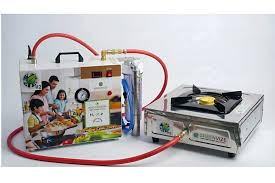
Well, a green-tech startup from India called GreenVize says it has made both possible with a hydrogen-based cooking unit that runs on water and a little bit of electricity.
The system utilizes an existing technology known as Proton Exchange Membrane electrolysis to produce hydrogen from water. This technology uses electricity to split water (H?O) into high-purity hydrogen (H?) and oxygen (O). A solid polymer electrolyte allows protons to pass through while separating the gases.
Hydrogen is collected and stored for various applications, while the oxygen is simply vented into the atmosphere. The startup's system makes the hydrogen immediately available as fuel, eliminating the need for storage. As the hydrogen burns, it interacts with oxygen in the air, creating harmless water vapor as a byproduct.
According to GreenVize, its plug-and-play system requires around 100 milliliters (3.38 oz) of distilled or reverse-osmosis water and approximately 1 kWh of electricity to deliver up to six hours of continuous cooking. By comparison, standard induction cookers are rated 1.5 to 2 kW. This means that for the same six hours of cooking, they consume 9-12 kWh.
"While both induction stoves and the GreenVize hydrogen cooking system use electricity, the efficiency, flexibility, and real-world usability are fundamentally different, especially for hotels, community kitchens, and high-demand cooking environments," said Sanjeev Choudhary, founder of GreenVize Energy Solutions, as reported by pv magazine.
Another beneficial feature of the system is the elimination of the requirement for storage, as it generates the hydrogen on demand. However, users also have the option of storage.
"In its standard configuration, the electrolyzer is directly coupled with the cooking unit, with hydrogen generated and consumed in real time, eliminating the need for storage. However, the system can also be configured with hydrogen storage, allowing production during off-peak hours or periods of solar generation and subsequent use during peak demand," said Sanjeev.
The product is priced at 105,000 Indian Rupees (about US$1,130) for a single-burner stove, and 150,000 Indian Rupees (US$1,610) for a double-burner stove.
So, should you rip out your induction cooking systems? After all, 1 kWh of electricity for six hours of cooking is simply a steal, plus there's "free oxygen" being released into the environment.
Well, hold your horses! It's time for some good ol' energy mathematics.