










Breaking News
 Trump On Iran: 'Lots Of Bombs Will Go Off' If No Agreement
 I Tested the Top 7 Salts for Toxins (Only 2 Passed)
 Is it possible to NOT pay federal income taxes legally?
 The Economic Destruction of Trump's War Goes Far Beyond High Gas Prices
Top Tech News
 Researchers Turn Car Battery Acid and Plastic Waste into Clean Hydrogen and New Plastic
 'Spin-flip' system pushes solar cell energy conversion efficiency past 100%
 A Startup Has Been Quietly Pitching Cloned Human Bodies to Transfer Your Brain Into
 DEYE 215kWh LiFePO4 + 125,000W Inverter + 200,000W MPPT = Run A Factory Offgrid!!
 China's Unitree Unveils Robot With "Human-Like Physique" That Can Outrun Most People
 This $200 Black Shaft Air Conditions Your Home For Free Forever -- Why Is It Banned in the U.S.?
 Engineers have developed a material capable of self-repairing more than 1,000 times,...
 They bypassed the eye entirely.
 The Most Dangerous Race on Earth Isn't Nuclear - It's Quantum.
 This Plasma Stove Cooks Hotter Than The Sun


Paula R-AI-dcliffe! Watch the moment a robot wins the Beijing half marathon...
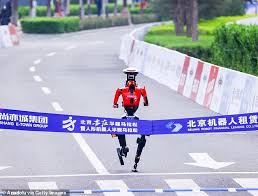
During last year's shambolic Beijing robot half marathon, humanoid machines tripped, shuffled, and occasionally shattered into pieces as they collapsed under the strain.
But 12 months later, supporters looked on in awe as a new generation of speedy robotic racers left the human athletes in the dust.
More than 100 robots competed alongside 12,000 human counterparts, separated by a barrier to prevent collisions.
Lightning, the winning bot developed by Chinese smartphone maker Honor, not only beat the best human that day but smashed the world record, set only last month.
The robot completed the 13.1-mile (21 km) course in a blistering 50 minutes and 26 seconds, far faster than the 57 minutes and 20 seconds record set by Ugandan runner Jacob Kiplimo.
That was more than three times faster than last year's winning robot, which finished the race in a time of two hours and 40 minutes.
In another stark example of just how quickly robot technology has advanced, nearly half of this year's entries raced autonomously, navigating the winding course without human intervention.
Honor, a Huawei spin–off company, bagged all three podium spots with self–navigating robots – all of which posted world–record–breaking times.
Not every robot competitor performed quite as well as Lightning, and there were still a number of robots that crumbled under the pressure.
In one incident, a robot tripped and collapsed before crossing the start line, bursting into dozens of pieces as it continued to thrash on the ground.
There were also familiar navigation errors, with robots bumping into barriers or suddenly veering off in an unexpected direction.
However, the overall quality of the humanoid robots on display was an astonishing improvement over the last race just 12 months ago.
Xioadi Du, an engineer from Honor's winning team, said that the record–breaking bot had been developed intensively over the last year.
The engineer said that Lightning had been fitted with extra–long 90 to 95 cm legs to mimic the build of human elite runners.
The robot is also fitted with liquid cooling technology to help manage the intense heat generated by its massive leg motors.
According to the state media outlet Global Times, one Honor robot actually posted an even faster time of 48 minutes and 19 seconds but was pushed off the podium under the weighted scoring rules for being remotely controlled.