










Breaking News
 Hedge Funds Underweight North American Stocks Despite S&P 500 Highs
 One solar panel every 30 seconds.
 FILM: The worst coup in history – How the banks stole our money & freedom (svensk text)
 Who Will Teach Donald Trump to Play Chess?
Top Tech News
 His grandparents had heart disease.
At 11, Laurent Simons decided he wanted to fight aging.
His grandparents had heart disease.
At 11, Laurent Simons decided he wanted to fight aging.
 Mayo Clinic's AI Can Detect Pancreatic Cancer up to 3 Years Before Diagnosis–When Treatment...
A multi-terrain robot from China is going viral, not because of raw speed or power...
 The World's Biggest Fusion Reactor Just Hit A Milestone
 Wow. Researchers just built an AI that can control your body...
 Google Chrome silently installs a 4 GB AI model on your device without consent
 The $5 Battery That Never Dies - Edison Buried This 100 Years Ago
 That is not a real fish. IT'S A ROBOT.
 Scientists Unveil Hemp Alternative to Plastic That Can Withstand Boiling Water...
 A Robot Economy: Who Gets Rich, Who Gets Left Behind


Zelensky and Ukraine Are in a World of Trouble
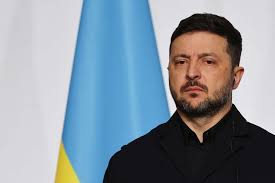
A world of trouble is dawning for Ukraine and its president, Volodymyr Zelensky. And not just because they are losing the war, which they are. Despite pro-Ukraine governments and media in Western countries overplaying Russia's losses in troops and underplaying its gains in territory, the reality on the ground is becoming increasingly hopeless for the eastern European country.
Russia's gains are not spectacular, but they are steady. They are slowly absorbing Donbas. The Russian advance is stretching the front line ever further. With Ukraine's serious manpower shortage, that is making their defensive lines ever more porous and vulnerable.
The hopelessness on the battlefield is being increasingly felt by Ukrainians who were promised a victory that would make the war worth the suffering.
Ukraine will not recover its lost territories. Even Ukraine's closest allies have conceded this point. At the end of April, German Chancellor Friedrich Merz said that when Ukraine finally signs a peace treaty with Russia, "it may be that part of Ukraine's territory is no longer Ukrainian."
The NATO dream is dead. And the EU dream is proving almost as illusive. Not only membership, but "membership light," is a distant hope. While Ukraine talks of membership by next year, the EU talks about next decade. Merz recently stated that accession by 2027 "is out of the question. It's not possible." He has suggested that it cannot happen until 2035 at the earliest.
But the trouble isn't just coming from outside the country, from a larger enemy's significant advantages and from key allies' diminishing confidence. It's also coming from Zelensky's government and the domestic political situation.
Ukrainians may be ready for a new leader. The sociologist Volodymyr Ishchenko of Freie Universität Berlin told The American Conservative, "at this point, all the electoral polls are entirely speculative" and the more reliable polling is on who Ukrainians trust the most. Zelensky is not doing well by that metric.
Recent polling by the Kyiv International Institute of Sociology in January indicates that 72 percent of Ukrainians trust former Commander-in-Chief Valeriy Zaluzhny and 70 percent trust former intelligence chief and current Zelensky chief of staff Kyrylo Budanov, while only 62 percent trust Zelensky—and the latter number has continued to fall. By April, Zelensky's number was 58 percent. Only 28 percent of Ukrainians say they want to see Zelensky stay on as president after the war. According to some polling, only 20 percent of Ukrainians would vote for Zelensky in the next election, though that is still 1 point ahead of Zaluzhny, his closest competitor. Other polling suggests that Zelensky would lose to Zaluzhny. Ishchenko told TAC that some readings of "closed polls" show that he would probably lose to Budanov.
Zelensky has also been facing unfamiliar resistance from within his own party where a number of MPs are boycotting or rebelling. His super-majority is reportedly at risk as a result of defections.