










Breaking News
 Tulsi Gabbard at center of explosive CIA claim as JFK and MKUltra files 'vanish from her office*
 Bessent Says US, China To Launch AI Safety Talks After Trump-Xi Meeting In Beijing
 Cuba Depletes Fuel As Blackouts Worsen, Putting Havana's Communists Under Pressure...
 Russia Sends Over 1500 Missiles, Drones On Ukraine In 48 Hours After V-Day Ceasefire
Top Tech News
 US To Develop Small Modular Nuclear Reactors For Commercial Shipping
 New York Mandates Kill Switch and Surveillance Software in Your 3D Printer ...
 Cameco Sees As Many As 20 AP1000 Nuclear Reactors On The Horizon
 His grandparents had heart disease.
At 11, Laurent Simons decided he wanted to fight aging.
His grandparents had heart disease.
At 11, Laurent Simons decided he wanted to fight aging.
 Mayo Clinic's AI Can Detect Pancreatic Cancer up to 3 Years Before Diagnosis–When Treatment...
A multi-terrain robot from China is going viral, not because of raw speed or power...
 The World's Biggest Fusion Reactor Just Hit A Milestone
 Wow. Researchers just built an AI that can control your body...
 Google Chrome silently installs a 4 GB AI model on your device without consent
 The $5 Battery That Never Dies - Edison Buried This 100 Years Ago



Separate Peace? Saudi Arabia Floats Regional Non-Aggression Pact With Iran
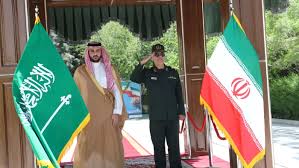
The report says Saudi Arabia is supposedly considering a non-aggression pact between the Middle East states and Iran after the military conflict between the United States and Iran ends, the FT indicates.
Citing diplomatic sources, it describes that Riyadh is assessing a model of the Helsinki Process, which helped reduce tensions in Europe during the Cold War, and created an uneasy East-West peace in post-WW2 Europe.
The driving rationale behind the potential diplomatic framework is that while Iran is "weakened," the reality is that it still "poses a threat to its neighbors."
An Arab diplomat cited by FT said that a non-aggression pact modelled along the lines of the Helsinki process is something likely to be embraced by most Arab and Muslim states, as well as by Iranian leader.
"It all depends on who is in it - in the current climate, you are not going to be able to get Iran and Israel... Without Israel, it could be counterproductive because after Iran, they are seen as the biggest source of conflict. But Iran is not going anywhere, and this is why the Saudis are pushing it," the source stated.
The Abraham Accords have theoretically attempted to build a normalization and non-aggression foundation involving Arab states and Israel, but other countries and populations in the region are suspicious of it for the very fact that it is seen fundamentally as a pro-US and pro-Israeli axis of alignment.
As for for Tehran and Riyadh, they recently have experience with direct, good faith talks, given that it was only in 2023 that China made history when it brokered a landmark normalization deal between Iran and Saudi Arabia - after which mutual embassies opened and went into operation.
This week, Reuters and other sources revealed for the first time that at the height of Trump's Operation Epic Fury which began in late February and endured through March into early April, the UAE directly fired back on Iran as it was under attack by drones and missiles. Also interesting is the fresh revelation that Israeli PM Benjamin Netanyahu made a secret visit to the UAE as the Iran war was in full swing - though UAE has officially denied it, perhaps not wanting to inflame Arab public sentiment.
Kuwait also reportedly directly attacked Iranian interests, and additionally the Saudis attacked Shia Iraqi militias seen as cooperating with Iran.