










Breaking News
 Mike Adams Joins Scott Kesterson to Discuss Local AI, Decentralized Intelligence and Human Freedom
 The James Corbett Book (and Movie!) Club
 Tiny, modular pod attacks macro photography's lighting nightmare
 Laser-beam mosquito shooter is now available for preorder
Top Tech News
 Portable 1MW Kaleidos Microreactor Secures Critical Nuclear Fuel Deal Through 2030s
 This New All-In-One Range Extender Is Ready To Go Into Any Electric Truck
 Aptera Reveals The Secret To Building Its Solar EV: China
 High-voltage sodium home battery emerges as affordable rooftop solar solution
 Peter Thiel-Funded Company Anduril to Triple the Number of Autonomous Surveillance...
 China has released Origin Pilot, claimed to be the world's first open-source operating system...
 ShieldAI XBAT Drone Fighters Can Give A Fighter Drone Wing to Every US Destroyer
 Brain organoids, kept alive more than five years, matured like human brains
 Parkinson's patient's tremors VANISH within minutes of GROUNDBREAKING treatment
 NEW HOMES ARE BUILT WITH THIS AND IT'S MAKING YOU SICK


Compasses, not maps: China is building a different type of AI
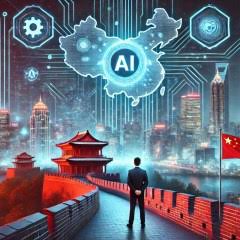
Every few months, another Chinese artificial intelligence (AI) breakthrough makes global headlines. A Chinese AI model closes in on American rivals, a Chinese research team tops a benchmark, a Chinese factory gets smarter, a city more connected, a supply chain more predictive.
The usual explanations follow: China has more engineers, more factories, more state support, more data. While often true, they miss something deeper.
China is not simply building bigger AI systems than America. From digital twins and smart cities to predictive logistics and intelligent manufacturing, it is increasingly building systems designed less for chatting than for coordinating, less for imitation than for management.
That difference points to a larger question. Why has China put so much emphasis on AI for navigating change, while much of the Western conversation has focused on chatbots, productivity software and artificial general intelligence?
The answer lies not only in economics or industrial policy, but in a much older Chinese way of thinking about intelligence itself.
The binary and the book
More than three centuries ago, an exchange of letters between Europe and Beijing brought together two very different ideas of intelligence.
In 1701, Gottfried Wilhelm Leibniz sent an explanation of his newly developed binary arithmetic to Joachim Bouvet, a French Jesuit at the court of the Kangxi Emperor. Leibniz had shown that every number could be expressed using only two symbols — 0 and 1— a discovery that would become foundational to digital computing.
Bouvet's reply surprised him. He sent a diagram of the 64 hexagrams of the I Ching, or Book of Changes, one of China's oldest philosophical classics. Each hexagram consists of six broken or unbroken lines, producing exactly 64 possible combinations.
To Leibniz, the resemblance was unmistakable. He concluded that the ancient Chinese had, in effect, anticipated binary arithmetic long before Europe formalized it.
That claim is too neat to take at face value. The I Ching was never a mathematical system. But Leibniz noticed something real: the hexagrams arrange discrete symbols in a way that invites pattern, classification and transformation.