










Breaking News
 The Homeless Industrial Complex:
 The Lucid Cosmos Will Have More Range Than Any Tesla
 Trump Admin Ends Medicaid Funding For Sex-Change Procedures On Kids
 Strong 3D printable elastic polymer resists damage
Top Tech News
 Vitalik Buterin Says Ethereum Is Betting Its Future On Quantum Security And AI
 Everything You Wanted To Know About Building A Cheap AI Setup (That Still Works)...
 If They Were Human, They'd Be Arrested. Experts Respond To Rogue AI Breaches
 Sodium Ion Batteries Will be 80% Cheaper & Last LONGER!
 German startup SAXON Q has introduced a diamond-based quantum computing system...
 Elon Musk To Build The Largest Building In The World - 100 Million Square Feet
 Bitcoin 'Red Team' Says AI Is Finding 100s Of Critical Exploits Across Core Projects
 EG4 Power Pro VS Ruixu Lithi VS Yixiang Budget Battery! Best Selling Battery Showdown!
 Insect wings can kill bacteria without any chemicals!
 Tesla Never Made An Electric Jet Boat, So This YouTuber Built One Himself



Total solar eclipse 2026 thrills millions with a stunning cosmic spectacle (photos, video)
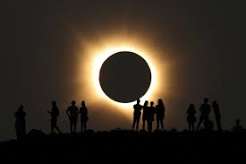
And just like that, it's over.
Total solar eclipses are incredible moments in time, but they are fleeting. As the moon passes directly in front of the sun and its shadow sweeps across Earth's surface, the temperature drops and the light takes on an eerie twilight quality. Birds and other animals go quiet. It's a spectacle unlike any other. And for millions today who were lucky enough to be in the path of totality across Greenland, Iceland and Spain, that's exactly what they experienced.
"I cannot believe what I just witnessed. I knew what to expect ?— I've seen thousands of photos but nothing compares to that feeling you get when you watch the sun transform before your very eyes," Space.com skywatching editor Daisy Dobrijevic said after watching the eclipse from the deck of the MS Spitsbergen on the HX Expeditions eclipse voyage in Scoresby Sund, Greenland on Aug. 12, 2026.
"It looked so big in the sky with the delicate corona streaming out into the abyss. Jupiter, Mercury and Venus even joined in the show. The huge prominence was the icing on the cake," Dobrijevic added.
"This is something I will never forget and I feel privileged to have experienced it in one of the most remarkable environments on Earth and alongside an incredible group of people aboard HX Expedition's MS Spitsbergen."
The 182 mile-wide (293-kilometer) path of totality — the line "drawn" on the face our our planet by the moon's shadow — began near Siberia over the Arctic Ocean and first arced down into eastern Greenland.
From there, the path stretched across western Iceland and then into northern Spain where millions gathered to witness the spectacle.
"It was the most incredible thing I've seen in my entire life," said Space.com skywatching writer Anthony Wood after witnessing the eclipse from Valoria la Buena, Spain alongside a team of citizen scientists from the Dynamic Eclipse Broadcast initiative. "It feels like it really shouldn't be happening. It strikes the lizard part of your brain that just tells you that this shouldn't be real."
The path then crossed the Balearic Islands just east of Spain before ending over the Mediterranean Sea as the sun set.
Eclipse-watchers inside the narrow path of the moon's shadow were given a rare naked-eye glimpse of the sun's outer atmosphere, known as the corona. Witnessing the crown-like shape of the corona stretching away from the dark shadow of the moon is one of the most breathtaking moments of an eclipse. Photographs don't do it justice, as they rarely do.
Outside of the path of totality, skywatchers throughout Europe and Scandinavia were able to catch a glimpse of a partial solar eclipse — in which the moon appears to take a "bite" out of the sun.
Space.com's Harry Bennett captured the partial eclipse from a hilltop in Somerset, England, shooting the scene with a Unistellar Equinox 2 smart telescope equipped with a solar filter.