










Breaking News
 Welfare Is Immoral in Any Country
 Hair-Raising Case: White Baltimore Arts Executive Fired For Wearing Cornrows
 The Honda NSX rises ... with more horsepower and carbon fiber
 'Hypocrite' Hillary Clinton is slammed for her comments on Fort Hood killer's...
Top Tech News
 Seven apps. One craft
 SHOCK CASE REPORT: Advanced Alzheimer's Patient Regains Speech, Memory, Mobility...
 Most artificial limbs rely on silicone or plastic to mimic human hands.
 Flying cell tower beams phone signal to Japan from 10 miles up
 Chinese Commercial Reactor Achieves Nuclear Fusion with Clean Hydrogen-Boron Fuel
 Med Beds Just Took a MASSIVE Step Forward, Healing People in Days!
 Palmer Luckey: Autonomous Weapons Are Ancient and Why Anduril Won't Build Humanoids | EP #295
 A laser just photographed objects through six feet of concrete
 Elon Musk's Next-Gen Motor Destroy Entire EV Industry
 China's disputed satellite refueling heralds new space war era



Polaris injects pneumatic shifting into expedition-grade side-by-side
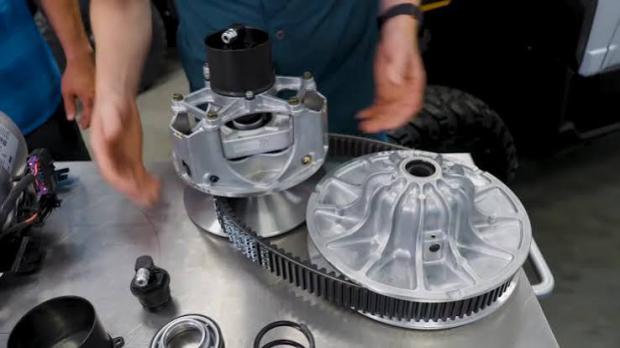
The transmission builds on the current mechanical CVT by adding pneumatics to soften noise and harshness when maximum rpm are not needed.
The system is redundant in that this isn't a brand new CVT design, it's an add-on to the existing mechanical design. An air compressor, a small air tank, and a pneumatic piston are added in order to control the CVT's output compression. If the pneumatic system fails for any reason, the CVT continues to operate mechanically, keeping the UTV trail-ready and operational.
Polaris' design for its mechanical CVT has been used in most of its vehicles for some time. It consists of a drive clutch and a driven clutch connected via a belt. The drive clutch, which is connected to the engine, is tower-shaped with springs and shift weights inside. At low RPM, it sits open. As engine speed rises, centrifugal force squeezes the drive clutch closed and pushes the belt farther outward. At the same time, the driven clutch, which is bell shaped, opens and lets the belt move inward. That shifts the CVT from a low ratio for more torque to a higher ratio for more speed.
With the added pneumatic system, Polaris engineers designed the addition to artificially compress the drive clutch with compressed air through a piston. Doing so reduces rpm, resulting in less engine noise, better fuel economy, and quieter CVT operation. The system is designed to have the pneumatics kick in during low-effort cruising or crawling when the vehicle does not require high torque. With a vehicle like the big Xpedition, for example, this results in a quiet cabin where a normal conversation level can be had when the pneumatics are engaged.
Control for when and how often the new air compression system does its thing is managed in any of three rocker switch settings. The simple switch includes Comfort, Standard, and Sport settings. With Comfort on, the system prioritizes lower rpm whenever possible. With Sport on, the system mostly ignores the pneumatics altogether, prioritizing speed and power. The Standard setting operates between the two extremes. The switch sits right next to the differential lock controls for off-road control.
The result of the pneumatic system on noise is significant. In Comfort mode, the noise levels in the unit at 35 mph (56 km/h) – which is considered "cruising speed" for the Xpedition UTV – drop by about 9 decibels, a 40% reduction versus the standard CVT's operation at that speed.
Adding an air compressor to the UTV has other benefits. The compressor is a very small, low-noise, high-output design that receives air through its own filtered nozzle. The connected tank holds just about enough air to inflate one of the unit's tires from nearly empty, or all four from off-road/air-down to fully aired up. This can be done through the Xpedition's new air nozzle built into the left-rear fender. A removable panel pops off (no tools required) to reveal the connector.