










Breaking News
 50 Survival Lessons From The Great Depression: The Horrifying Things Americans Did When Money...
 'Our Military Is Helpless': Migrant Ambush Targeting Military Vehicles In Ceuta Was Pre-Plan
 How Much Gas Prices Have Risen Since The Iran War
 THE HUNGRY DECADE
Top Tech News
 Singapore is experimenting with biological computing using living human neurons...
 It's Happening - Europe is Building an Impossible Fusion Reactor
 Portable 1MW Kaleidos Microreactor Secures Critical Nuclear Fuel Deal Through 2030s
 This New All-In-One Range Extender Is Ready To Go Into Any Electric Truck
 Aptera Reveals The Secret To Building Its Solar EV: China
 High-voltage sodium home battery emerges as affordable rooftop solar solution
 Peter Thiel-Funded Company Anduril to Triple the Number of Autonomous Surveillance...
 China has released Origin Pilot, claimed to be the world's first open-source operating system...
 ShieldAI XBAT Drone Fighters Can Give A Fighter Drone Wing to Every US Destroyer
 Brain organoids, kept alive more than five years, matured like human brains



The geopolitical imperative for a self-reliant South Korea
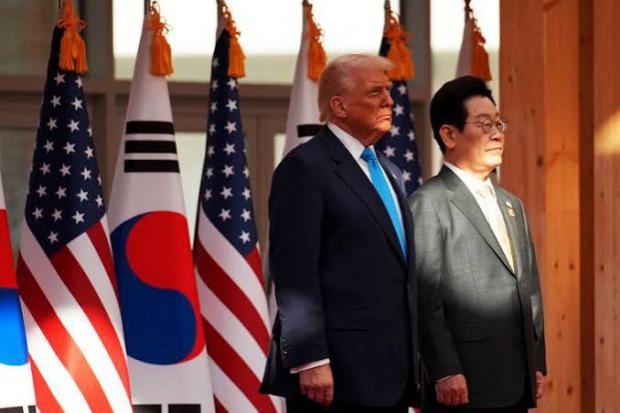
US President Donald Trump's abrupt directive on August 16, 2026, to drastically scale back the joint "Ulchi Freedom Shield" (UFS) military exercises sent shockwaves across the Asia-Pacific geostrategic landscape.
The unilateral announcement, posted to social media mere hours before the large-scale maneuvers involving 18,000 South Korean troops were set to launch, was justified by Washington on grounds of cost efficiency, claims of a close personal rapport with North Korean leader Kim Jong Un and executive frustration over South Korean President Lee Jae-myung's refusal to commit Seoul's military to denuclearization operations against Iran.
This transactional and unilateral maneuver directly fractures the foundation of the US-led extended deterrence doctrine, which has served as the bedrock of stability on the Korean Peninsula for over seven decades.
When a nation's security guarantees can be summarily revoked to accommodate Washington's domestic political calculus, absolute reliance on the American defense umbrella ceases to be a protective asset. Instead, it becomes an existential vulnerability threatening national survival.
This new geostrategic reality compels South Korea to face an unavoidable historical crossroads. Discourse surrounding strategic autonomy has shifted radically: transitioning from a progressive academic debate into an urgent geopolitical imperative to safeguard national sovereignty against the erratic behavior of its principal ally.
The American dilemma
Washington's unilateral decree demands an accelerated transfer of Wartime Operational Control (OPCON) to the South Korean military. Although evaluations for Full Operational Capability (FOC) are slated for completion in 2026, severe systemic gaps in intelligence, surveillance, and reconnaissance (ISR) integration continue to cast a long shadow over Seoul.
Limitations in independent satellite monitoring to track North Korea's highly mobile missile launchers and subterranean installations leave South Korea heavily dependent on Washington's early-warning satellite network.
Without integrating AI-driven automated target recognition and rapidly deploying low-Earth-orbit micro-satellite constellations, assuming operational command risks creating critical tactical blind spots.
A parallel fragility haunts the paradox of South Korea's defense industry (K-Defense). Despite remarkable global export surges, ranking 10th worldwide with a US$47.6 billion defense budget in 2024, South Korea's military technology supply chain remains tightly tethered to US licensing.
A staggering 86% of South Korea's total arms imports between 2020 and 2024 originated from the United States, while flagship platforms such as the KF-21 fighter jet and FA-50 light attack aircraft rely heavily on Washington-licensed engines and components.