










Breaking News
 Communism is SO attractive to the elite because it gives them ALL OF THE POWER...
 First the fake medical degrees, now fake regular degrees!
 One of Wall Street's Best Hedge Funds Just Blew a 44% Gain Because of AI Bets
 Iran and Pakistan are mass deporting millions of Afghans back to Afghanistan.
Top Tech News
 Anduril's plan to save US sub edge from China's undersea surge
 Researchers Develop AI 'Mind-Reading' Tool That Reconstructs What Your Eyes See
 Video: Dexterous robot hand learns the delicate art of silk embroidery
 The computer that can read your mind:
 Seven apps. One craft
 SHOCK CASE REPORT: Advanced Alzheimer's Patient Regains Speech, Memory, Mobility...
 Most artificial limbs rely on silicone or plastic to mimic human hands.
 Flying cell tower beams phone signal to Japan from 10 miles up
 Chinese Commercial Reactor Achieves Nuclear Fusion with Clean Hydrogen-Boron Fuel
 Palmer Luckey: Autonomous Weapons Are Ancient and Why Anduril Won't Build Humanoids | EP #295



How a Group of Young Men in 1933 Solved a Water Crisis in The Desert -- And Nobody Knows About It
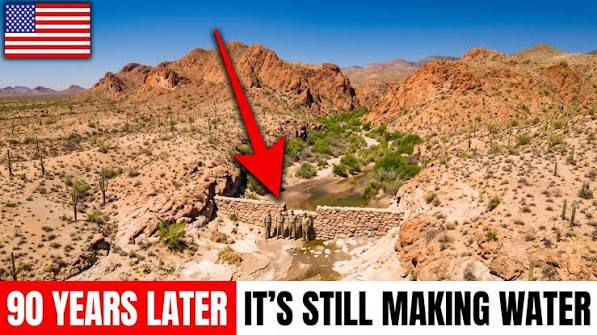
Deep inside Saguaro National Park in Arizona, small rock-and-cement check dams built during the Great Depression are still changing how water moves through the Sonoran Desert. Beginning in 1933, young men from the Civilian Conservation Corps (CCC) constructed these masonry barriers to fight severe erosion—and decades of accumulated sediment eventually created something unexpected: persistent water in one of North America's driest landscapes.
This documentary explores how the Civilian Conservation Corps check dams helped restore degraded desert canyons after decades of overgrazing had stripped vegetation and accelerated soil loss. Unlike conventional dams, these structures were never designed to permanently block water. Their purpose was simpler: slow violent monsoon runoff, reduce erosion, and trap sediment.
Over successive storms, layers of sand, clay, and fine material accumulated upstream. That porous sediment began acting like a natural underground reservoir, absorbing monsoon water and releasing it gradually long after the surrounding desert surface had dried. The script traces this process to a spring near the historic structures, surrounded by greener vegetation and concentrated wildlife.
Nearly 90 years of monsoons, extreme heat, and winter freezes have tested structures built largely by hand from materials found directly in the canyon. Their story connects the Civilian Conservation Corps, Saguaro National Park history, Sonoran Desert restoration, check dams, erosion control, sediment capture, water harvesting, groundwater infiltration, watershed restoration, and drought resilience.