










Breaking News
 Bessent: "CUT THE SNAKE'S HEAD OFF"--But Who is the Real Target?
 Special LIVE Saturday Show: Could The Gov Seize XRP After Chilling FDIC Admission? Gas Prices...
 Starbase Louisiana 101: A Look At Elon's New Space City
 Germany Braces For AfD Election Breakthrough In Saxony-Anhalt
Top Tech News
 Floating data center would provide water and electricity to 32,000 homes
 OpenAI Cuts Off Elon's Cursor, Humanity's First Star Probe, and Trump's Nuclear Mars Shi
 Eating pollution? Plastic-to-cookie technology raises safety, environmental concerns
 Ford's $30,000 Fathom EV Truck Appears More Conventional Than Expected
 Berlin-based artist Simon Weckert explored that idea with Digital Camouflage...
 Tether expands tokenization business into Saudi Arabia, starting with real estate
 Ukraine is facing a new problem in its war with Russia:
 It charges more than it discharges while driving
 Dataminr AI tech to go live on NATO Maven system: CEO
  The Most Dangerous Interview Ever Recorded? PART 2


Starbase Louisiana 101: A Look At Elon's New Space City
In response, Deutsche Bank analyst Edison Yu takes a closer and identifies four main reasons including i) orbital trajectory (optimizing for ODCs), ii) geography, iii) regulation, and iv) propellant (bringing processing/production onsite).
New Starbase
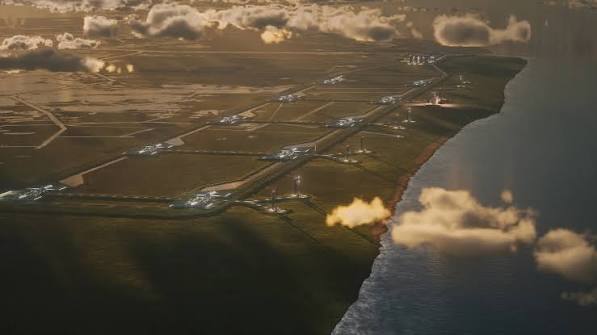
SpaceX announced a new $100 billion Starship launch site in Louisiana last week with initial plans to build five two-pad complexes or ten towers. Longer term, Elon Musk commented there could be over twelve towers capable of launching more than 30 flights daily. The site is expected to be materially larger than Starbase Texas and essentially be a "space city" with on-site fuel processing/production, dedicated power generation, deep-water port, employee housing, and potentially an airport; Starship manufacturing however will seemingly not occur here. Construction is slated to begin next year with first launch slated for no earlier than in 2029 (2030 is more realistic). Headline investment amount is $100bn although this could span over a decade. The exact location will be an area called Pecan Island (~125k acres), located in the Vermilion Parish which is on the Gulf of America coast. The site was formerly owned by ExxonMobil and was transferred to the state following settlement of a coastal environmental lawsuit. SpaceX expects to create about 10,000 jobs with 60-80% being locally hired.
Rationale #1 - Orbital trajectory
To establish some basic principles: the Earth's spin is fastest at the equator. Therefore, a rocket launching eastward starts with that speed already in hand. The further from the equator a launch site sits, the less benefit from that free push. Inclination is the angle an orbit makes with the equator. For example, a satellite in a 0° orbit circles above the equator; one in a 90° orbit passes over both poles. The rule is essentially a rocket can most efficiently reach any orbit whose inclination is at least the latitude of its launch site. Reaching a lower inclination requires an expensive mid-flight turn, burning fuel that could otherwise have carried payload. Azimuth is the compass direction the rocket flies after liftoff. Rockets shed spent stages and occasionally fail, so regulators only permit trajectories where debris would fall over open ocean water or empty land.
As discussed in our Data Centers in Space series, SpaceX is seeking to deploy a large number of orbital data centers. The ideal position for these satellites is a type a sun-synchronous orbit (SSO) running along the day-night boundary ("dusk-dawn orbit"), to maximize continuous sunlight. To launch to SSO, the rocket needs to fly nearly due north or due south. That means a launch site with open water or empty land in that direction is optimal. SpaceX's existing Starship site at Boca Chica sits at the southern tip of Texas, on the Mexican border. It launches east over the Gulf of America because southerly trajectories run into Mexican territory almost immediately. So while it is a decent site for the orbits Starship has been testing into, it is not ideal for high volume SSO launches. In comparison, a site on the central Louisiana coast sits further from the Mexican coastline and opens a long southerly corridor over open water.