










Breaking News
 The State Spins a New Idea for Recruiting in an Age of War
 Woke Nike Booted from S&P 100 as Stock Crashes on Dismal Sales
 Triple-threat WIG hydrofoil aircraft makes maiden flight
 Not a single straight line: Spaceship-like Lucas Museum lands in L.A.
Top Tech News
 Floating data center would provide water and electricity to 32,000 homes
 OpenAI Cuts Off Elon's Cursor, Humanity's First Star Probe, and Trump's Nuclear Mars Shi
 Eating pollution? Plastic-to-cookie technology raises safety, environmental concerns
 Ford's $30,000 Fathom EV Truck Appears More Conventional Than Expected
 Berlin-based artist Simon Weckert explored that idea with Digital Camouflage...
 Tether expands tokenization business into Saudi Arabia, starting with real estate
 Ukraine is facing a new problem in its war with Russia:
 It charges more than it discharges while driving
 Dataminr AI tech to go live on NATO Maven system: CEO
  The Most Dangerous Interview Ever Recorded? PART 2


Not a single straight line: Spaceship-like Lucas Museum lands in L.A.
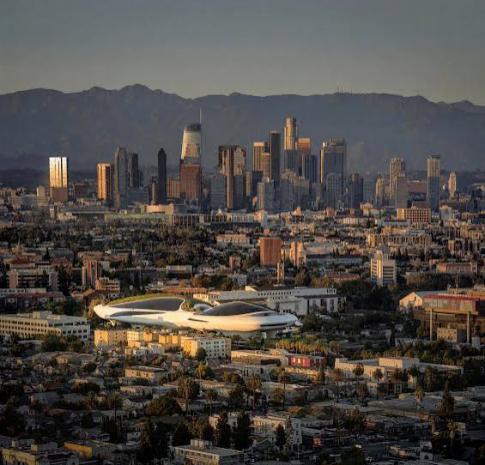
Looking like a strange spaceship has landed in Los Angeles, the incredible building holds a huge amount of art dedicated to storytelling – everything from Star Wars props to ancient Egyptian pottery.
Designed by MAD Architects, the museum is a real labor of love by George Lucas and his wife Mellody Hobson, and is funded by the couple themselves. The journey from pencil and paper to brick and mortar has been a long and arduous one, and has as many twists and turns as one of the director's Hollywood movies. First unveiled for Chicago back in 2014 and featuring a bulbous volcano-like form, it ended up undergoing a much-improved redesign and relocation to Los Angeles, with an originally planned completion date of 2021.
Was the wait worth it? Probably. This is a singular experience, both inside and out. Anchoring a 13-acre (5.3-hectare) public green space designed by Mia Lehrer, the building's seismically resistant concrete and steel structure is finished in 1,200 fiberglass-reinforced polymer panels. Each panel is individually shaped and positioned. According to MAD, the technology to create these panels to the standard required was only developed in recent years and they were fabricated using a combination of both robotics and human handcrafting expertise.
As much as we might think it looks futuristic and extra-terrestrial (something that can be said for most of MAD's architectural output, in all fairness), the building is actually intended to be an extension of the surrounding park. According to the designer, there isn't a single straight line on the main exterior shell, and its enormous curving form is raised to create a huge sheltered plaza beneath. A central steel arch spans 185 ft (56 m), while an elliptical oculus positioned four stories above provides visitors with a view up into the sky.
The museum's five-story interior hosts over 30 galleries dedicated to tracing visual storytelling across millennia. One key focus of the project, mentioned by Hobson, is creating a "museum of the people's art," and this does indeed play out, with a self-portrait by legendary Mexican artist Frida Kahlo rubbing shoulders with Star Wars production art depicting Luke Skywalker and Darth Vader battling each other – something that's bound to annoy more traditionally minded art critics. It also features two state-of-the-art theaters, a horseshoe-shaped library, classroom spaces, a shop, a café, and more.
There are some green touches, too. A large waterfall-like fountain on the northwest corner of the campus is connected to an intricate cooling system made up of 714 geothermal wells, each drilled to a depth of 365 ft (111 m) to help dump excess heat into the ground. Additionally, the curving roofline hosts a large solar panel array, along with a green roof section. In the park itself, 300 new trees have been planted, plus it includes a hanging garden, an amphitheater, a meadow, and multiple places that encourage socialization.