










Breaking News
 BREAKING: A fusion startup says it has turned mercury into gold, producing 10 times more...
 The Air Force's Vindictive War on Lance Castle: Ruthless Retaliation After a COVID Mandate...
 I don't think people realize what Elon Musk is actually doing.
Un-American Crazy People Running for National Offices
Top Tech News
 Genetically Engineered War Dogs for 134 Pound Cyborg Dire Wolves Now – Later 600 Pound Wolves
 They're Quietly REPLACING Our Food With THIS… And Nobody Is Talking About It!
 Chicago Opens First "Teacher-Free" AI School as Global Push Accelerates
 Solar Panels Are Doing Something Nobody Expected
 DeLorean climbs skyward to race electric flying cars
 Atari's 800XL returns with a keyboard, cartridges and BASIC
 Bioinspired robot airdrops into remote waters via morphing wing-sail
 Anduril interceptor adapts to emerging threats via swappable stages
 I Built a Website to Expose Solar and Battery Scams
 Whistleblower Issues Dire Warning: Rogue AI, Hacking Nuclear Programs...



Shoei GT-Air 3 Smart helmet drops with built-in AR for $1,500
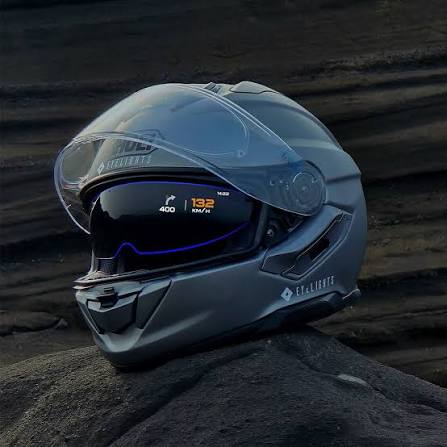
The helmet has been developed through a collaboration between Shoei and Eyelights, a company best known for making GPS, heads-up display, and Bluetooth audio kits, and the one-off eccentric concept based on the Triumph Rocket.
That's a bold move from a prestige manufacturer like Shoei. Having built helmets since 1959, Shoei isn't a startup taking a wild gamble on an untested product line. There's little room for error for a brand of this caliber, but this release has the potential to reshape the helmet market going forward.
The GT-Air 3 is a logical starting point, given it's one of Shoei's top sellers. What makes it "smart" is its ability to project crucial information, such as GPS navigation, speed, calls, and music, directly onto the visor. With Google Assistant and Siri built in, you can issue voice commands without touching your phone.
The key feature is the projected image, which appears at a focal distance of roughly 3 m (9.8 ft) in front of you. Because your eyes don't need to re-focus on a close object, you can absorb navigation data while keeping your visual attention squarely on the road ahead.
The hardware setup includes an optic module that slots neatly into the center of the helmet, an antenna, a noise-canceling microphone, speakers, a battery offering over 10 hours of runtime, and side controls. It also functions as a universal intercom system that is compatible with other brands and isn't restricted by range or group size.
Underneath the tech, the underlying lid remains a high-end touring helmet. It features an AIM shock-absorbing shell, a multi-density EPS liner, ECE 22/06 homologation, an Emergency Quick Release System (EQRS), and a Pinlock-ready CNS-1C visor. Comfort features include an internal QSV-2 sun visor and multiple ventilation channels with closable brow and chin intakes alongside rear exhaust vents.
The head-up display (HUD) remains the focal point. The flaw with looking down at a phone or handlebar-mounted GPS display isn't that the data is hard to read, it's that your eyes leave the road. On a motorcycle, spending even a fraction of a second looking down can have far more severe consequences than it does behind the wheel of a car.
Despite the tech, the system doesn't turn the helmet into a clunky wearable smartphone. Instead, it aims to make the underlying hardware vanish into the helmet's design. The communications unit is integrated directly into the shell structure to preserve aerodynamics. The bulky, externally mounted comms unit is gone.
EyeLights' system relies on a full-color Nano-OLED display rated up to 5,000 nits for high-sunlight visibility. The distraction of dipping your chin to read an instrument cluster is gone.