










Breaking News
 The AI Bird-Flu Scenario They Just Published
 Japan's first robot ambulance works the 9-1-1 lines for humanoids
 Cheap smartphone add-on pinpoints hidden cameras to shut down spies
 The $600 Tank That Beats a $10,000 Powerwall
Top Tech News
 Terrifying AI Behavior Even Its Creators Couldn't Explain
 WW3 Near-Miss? AI Hallucinated Nuclear Weapons Components Aboard Chinese Vessel Bound For Iran
 Stripe Is Building the Toll Road for the Machine Economy
 Toyota Dakar hopeful swaps twin-turbo V6 for hydrogen fuel cells
 4-min turbo-inflatable cubic camp castle is now available in the USA
 Researchers Used Claude To Hack OpenAI Employee Accounts
 Chinese Scientists Develop New Oil Refining Method That Cuts Energy Use by 90%
 World's smallest CT scanner fits in the palm of your hand
 The Tesla Roadster will blow people's minds
 Peter Thiel-Funded Company Anduril to Triple the Number of Autonomous Surveillance Towers...



Cheap smartphone add-on pinpoints hidden cameras to shut down spies
There have been far too many cases of people finding cameras in places they didn't belong: hotel rooms, bedrooms, and bathrooms in Airbnb rentals. The problem became serious enough that Airbnb announced a global ban on indoor security cameras a couple of years ago.
But, of course, saying that something is illegal doesn't magically stop people from doing it. If only there was a hidden-camera detector: effective, cheap, and small enough to take with you when you travel.
Well, researchers may have come up with exactly that. A team at the Korea Advanced Institute of Science and Technology (KAIST), in collaboration with the National University of Singapore and Singapore Management University, has developed a device called SweepLED.
The basic idea behind finding a hidden camera is simple: shine light at a suspicious object, and look for the bright reflection that bounces back from the camera's lens. In fact, devices utilizing this concept already exist.
But they're not that effective ... guess why? Because there are dozens of shiny objects in every apartment or hotel room: mirrors, lamps, glasses, pots, glossy plastic – and they all reflect light. Existing detectors struggle to distinguish between the reflection from a toaster and the reflection from a hidden camera, leading to false positives.
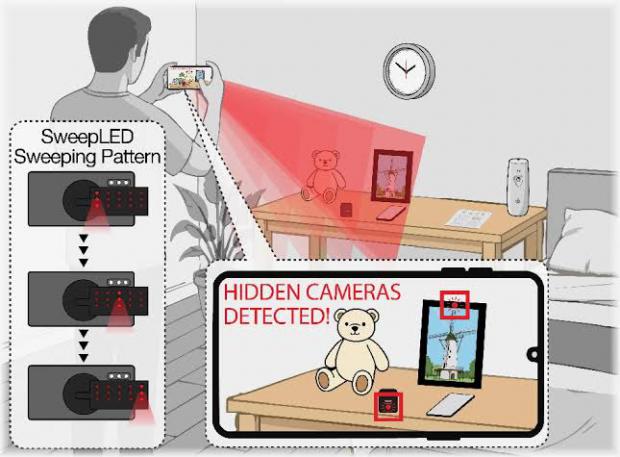
SweepLED is designed to tackle this problem. Instead of looking at a single bright spot, it analyzes how the reflection changes as the light moves, and that's the key innovation.
The device uses a small LED array built into a smartphone case. The prototype has 15 LEDs, and the hardware costs about US$7, which is quite a bargain for protecting your privacy.
Here's how it works ...
You point the phone at a suspicious object and hold it still for a few seconds. The LEDs on the back of the phone case rapidly sweep light across the object from different angles, while the phone's camera records the reflection. Both a normal shiny object and a hidden camera lens can reflect the light, but their reflections behave differently as the angle of the light changes.
And this is where things get interesting. Camera lenses have a distinctive optical structure, which produces very particular reflection patterns as the illumination changes. Those unique patterns are what the device is looking for.
The phone records the reflection changes and sends the video to software that processes and analyzes the footage. First, the system stabilizes the recording, because the phone could be moving slightly. Then, it compares frames captured with the LEDs on and the LEDs off to isolate the reflections produced by the LED sweep.
The researchers use an AI model trained to track and analyze changes captured over time rather than just looking at a single image. Basically, instead of pointing out all the shiny things, it looks for those whose reflection changes in a particular way.