










Breaking News
 Diesel Export Ban Off The Table? Ted Cruz Relays White House Assurances To Refinery Heads
 Saudi, Turkish, Pakistani Military Chiefs To Hold Urgent Meeting Over Yemen War
 The Commercial Real Estate Crash Is Moving From Paper Losses To Realized Losses
 Ceasefire Begins After Trump and Iran Forget Whose Turn It Was To Attack The Other
Top Tech News
 Tesla Model 3 killer charges from 10 to 97% in just 9 minutes
 World-first unpowered DNA computer sets speed record
 I Power 5 Buildings Off-Grid. Here's How
 The US government is pushing hard to get a working nuclear fission reactor into space by late 2028
 SpaceX Starmind AI in Space Radiator
 China Will Dominate Global Nuclear Energy Through 2035, Analyst Says
 These Absolutely Wild-Looking EVs Are Saudi Arabia's First Homegrown Cars
 BEYOND THE MOON: NASA plans a nuclear-powered fleet to push DEEPER into space
 Big Oil Backs Mazama's $135 Million Bet On Superhot Geothermal
 Quantum compass takes flight on Northrop's Lumberjack drone


Inside The Texas Factory Racing To Break China's Grip On EV Magnets
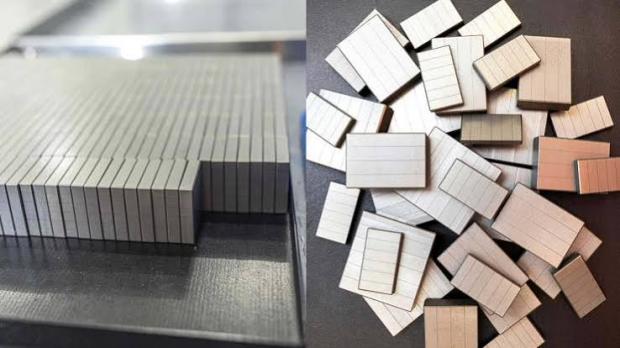
Inside MP Materials' "Independence" factory in Fort Worth, Texas, items that look like gum strips, corn flakes, and crushed pepper are laid out on a table. A giant U.S. flag hangs from the ceiling, and employees wearing protective thermal suits work near equipment where temperatures surpass 1,000 degrees Celsius. Under bright white lights, a shiny red Cadillac Vistiq gleams with its electric motor ripped open on a table, revealing what's inside: rare earth magnets.
The magnets are tiny, roughly equivalent to a miniature Hershey's candy. They feel robust and solid to hold, with smooth texture and sharp edges. Above all, their importance is hard to overstate. They're used in everything from military weapons and fighter jets to medical devices, iPhones, and electric vehicles.
There's just one big elephant in the room: China dominates the production of rare earth magnets. The country has the largest known rare earth reserves in the world, accounting for 49% of global supply, according to the International Energy Agency. Virtually all the rare earths used in the U.S. currently are sourced from overseas, giving Beijing incredibly strong leverage over its trading partners.
After the Trump administration imposed sweeping tariffs on Chinese goods last year, China retaliated with export controls on rare earth magnets, sending U.S. companies that depend on them scrambling to secure supply. Ford even suspended production of the Explorer SUV for a week because a supplier ran out of magnets. The U.S. eventually caved to Chinese pressure by trimming the tariff percentages, although China's reduced export controls are still in effect.
Now American rare earths specialist MP Materials is attempting something that hasn't been done in decades: resuscitate the rare earths supply chain in the U.S. It owns and operates Mountain Pass in Southern California's Mojave Desert, the only rare earth mine and refining facility in the Western hemisphere and the largest of its kind outside China, according to the company.
Its Independence factory in Fort Worth turns the raw material from that mine into automotive-grade magnets for electric motors. In a boost to that effort, General Motors is partnering with MP Materials to source EV magnets domestically and protect itself from policy swings and tariff chaos. It's part of GM's vision of localizing its EV supply chain, a mission that's looking more urgent by the day.
[Full Disclosure: General Motors invited me to tour the Independence factory in Texas. It paid for travel and accommodations.]
Why EVs Need Rare Earth Magnets
The buttery-smooth acceleration in EVs, the instant torque, and the excellent energy conversion efficiency compared to combustion engines—all this has a strong connection to the quality of the rare earth magnets used in traction motors.