










Breaking News
 Hard Choices...
 WHO Kills MAHA-Backed Hepatitis B Baby Vaccine Trial
 Lula Leads After Last-Minute Voting Extension As "Bolsonaro Trade" Implodes
 Grok Bot Tutorial: Beginner to Genius (Full Walkthrough)
Top Tech News
 Modular phone promises total privacy at the flick of a switch
 Genetically Engineered War Dogs for 134 Pound Cyborg Dire Wolves Now – Later 600 Pound Wolves
 They're Quietly REPLACING Our Food With THIS… And Nobody Is Talking About It!
 Chicago Opens First "Teacher-Free" AI School as Global Push Accelerates
 Solar Panels Are Doing Something Nobody Expected
 DeLorean climbs skyward to race electric flying cars
 Atari's 800XL returns with a keyboard, cartridges and BASIC
 Bioinspired robot airdrops into remote waters via morphing wing-sail
 Anduril interceptor adapts to emerging threats via swappable stages
 I Built a Website to Expose Solar and Battery Scams



A Western Civ Speech Only A Neocon Could Love
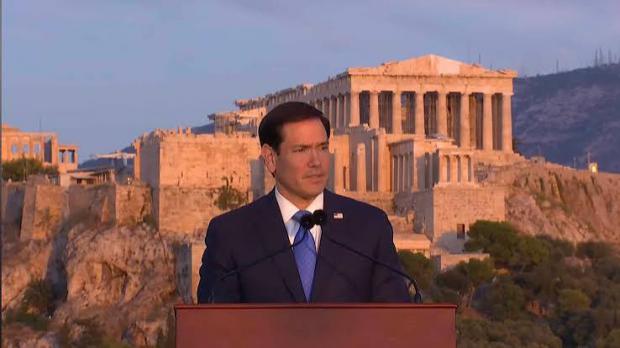
It was worth the viewing, if only for the craftsmanship involved. It was set in the golden hour, with the Parthenon beautifully framed behind Rubio, bathed in the soft light of the setting sun.
It was as well written as it was visually staged, although it had none of the eloquence of a Ronald Reagan address. ("These are the boys of Pointe du Hoc. These are the men who took the cliffs. These are the champions who helped free a continent. These are the heroes who helped end a war.") Soaring oratory like that is generally the joint effort of the speaker and the speechwriter, and while Rubio is a capable extemporaneous speaker, he doesn't have the Gipper's oratorical gifts.
In my friend's view it was a defense of Western civilization, which we agree can stand some defending, especially while it is burning in France. The speech's emphasis on the civilizational virtues of strength, duty, and ambition was designed to give it a Teddy Roosevelt flavor, as though Rubio wished to dawn the pince-nez of that robust imperialist. But qualities like ambition are themselves neutral. They are subject to human intention and can be put to uses fair or foul. Ambition to learn or create can be laudatory, but ambition to conquer others is another matter. As imperialist polemics do, it revealed the speaker's psychological blind spots. The irony is rich that on the very day that Rubio invoked Iran's "cult of death," his cabinet co-equal at the Pentagon announced that a forthcoming execution would be livestreamed for public consumption.
Rubio neglected to account for President Donald Trump's continuous death-wielding threats of Iranian annihilation: "A whole civilization will die tonight"; "You'll be living in Hell"; "Back to the stone ages where they belong."
In September at the United Nations, Trump said that if Iran doesn't accede to a deal, "they won't exist any longer." The man can't help himself. He is the consummate deal breaker himself, most notably the 2015 Joint Comprehensive Plan of Action nuclear agreement as well as his own June 17 ceasefire's Memorandum of Understanding. Within days of signing that ceasefire, Trump was back to threatening an invasion, despite the agreement's no-threats clause.
"Do I drive them into hell with no chance of survival?" he pondered. It all sounds like a death cult centered in Washington, but as happens so often among warmongers, Rubio's projection of these shadow outbursts onto the adversary wins the day.
What was missing, the dog that didn't bark, made Rubio's speech something that only a neocon could love. The throughline was all about war, about risk and glory, the pursuit of national power, and skyrocketing war spending. Yet conspicuously absent was the centrality of the individual and the evolving preeminence of freedom in the flowering of Western Civilization. No speech can cover everything, but in a narrative that stretched from Athens through Rome and from Christendom to America, there was only a paltry reference to the "English genius for liberty" (now, alas, mostly forgotten there), and something about "fierce individuality."
The liberal tradition that is central to Western civilization sees the individual as the bearer of rights, the locus in which conscience manifests itself. It is in the individual that freedom is experienced. Yet these jewels in the crown of Western civilization were crowded out by the speech's undisguised imperial core: national power, relentless ambition, adventure, risk and glory, skyrocketing defense spending, historic defense commitments.