










Breaking News
 Tiger Woods GOES NUCLEAR After Caitlin Clark BREAKS Guinness Record At RSM Classic
 2026-10-28 -- Ernest Hancock & Professor James Corbett - MP3&4
 Oman calls for Gulf, Iraq and Iran to unite under one security pact
 Israeli Media: Saudi Arabia Offered Ansar Allah $1 Billion for Yemen Ceasefire
Top Tech News
 Ancient Builders Moved Stones We Still Struggle to Explain
 Startup Unveils "Big Iron" Rocket Whose Upper Stage Is An Orbital Data Center
 The NYPD's New Cell Tracker Is Built For Mobility
 Electronic skin instantly displays touch as light
 $10k EV hatch packs in 5-minute flash charging
 Apex Recordhunter electric drone sets unofficial speed record
 Space-age manna: USAF & SpaceX drop survival kit from orbit
 World's first nuclear fusion power plant coming to WA | FOX 13 Seattle
 Advanced Small Modular Reactors (SMRs)
 A U.S. energy startup has demonstrated a new type of nuclear reactor that uses existing nuclear...



Electronic skin instantly displays touch as light
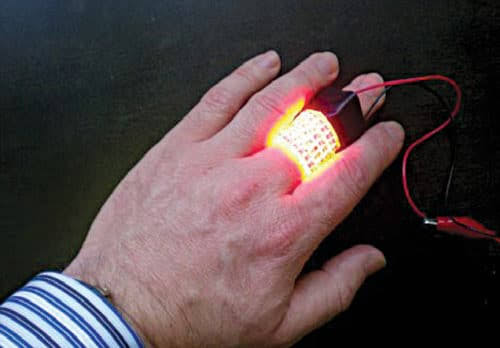
Researchers at the National University of Singapore (NUS) have developed an ultrathin, flexible electronic skin that lights up when touched, revealing exactly where pressure is being applied and how much, sort of like a skin with a screen. Dubbed the eLuminator, the device combines pressure sensing, measurement, and visualization in a single device.
It works by converting physical pressure directly into visible patterns of light, enabling users to see the shape and distribution of contact almost instantly, without requiring a separate display or complex signal processing. At just 70 micrometers thick, the artificial skin has an impressive resolution of 847 dots per inch (dpi), fine enough to detail individual fingerprint ridges. Potential applications include robotic sensing, surgical instruments, and wearable healthcare devices.
Thanks to a sophisticated feedback system involving our skin, nervous system, and brain, we know exactly how much pressure is involved when we touch, grasp, or press against something. The same thing happens in reverse scenarios. When we grab an egg, for example, specialized nerve endings in our skin instantly detect pressure and deformation, sending signals to our brain that help us judge how firmly we're holding it and adjust our grip accordingly. This is also how we can tell the difference between a gentle love tap and a full-on slap across the cheek.
Now, replicating this sense of touch in machines is a little more complex. Scientists have developed artificial electronic skins that allow robots, prosthetic limbs, and medical devices to detect physical contact and measure pressure. These typically incorporate arrays of tiny pressure sensors that convert applied force into electrical signals.
The signals are transmitted to a computer or electronic controller, which processes the data to determine where contact is occurring and how much pressure is being exerted. The information can then be used to control a robot's movements or provide feedback to a human operator as numerical readings or a visual pressure map on a separate screen, or through haptic interactions such as touch, vibration, or physical resistance. See what we mean … a little complex.
A good example is an inflatable prosthetic hand by MIT researchers that senses touch using a flexible tactile matrix spread across the device's surface, and translates that data into physical touch sensations mapped directly onto the user's remaining skin tissue. Johns Hopkins University researchers created a similar prosthetic device that instead maps pressure variables and sends them back to the observer using an electromyography (EMG) link hooked directly into deep muscle and nerve pathways.
The problem is that existing electronic skins and their feedback systems often require numerous separate components, including sensing elements, electrical connections, signal-processing circuits, and external displays or haptic devices. This adds complexity and bulk, especially when trying to fit everything onto small, flexible surfaces.
Many designs also rely on grids of individual sensing points, which limits how finely pressure can be mapped. Packing more sensors into the same area can improve resolution but also adds wiring and potential signal interference. Furthermore, rigid or semi-rigid components create significant conformity challenges. Imagine if your skin were a rigid, unyielding surface.