










Breaking News
 Days-Long Strike Campaign On Table As Trump Links Iran To Chemical, Biological Weapons
 Minnesota's New Somali-Born Democrat Lawmaker Has A Wife Problem
 Trump Dismisses Concerns About Wave of Outages:
 Iowans brace for a lead dust cloud as Army plans to detonate 5 tons of bomb-making chemicals
Top Tech News
 Extraterrestrial habitats may rise via Legos of laser-fused moon dust
 Battery-only 19-seater puts China in the electric airliner race
 Dream Chaser space plane gets landing approval for debut mission in 2027
 SpaceX Just Caught Starship on Its FIRST Attempt!
 Solid-State Cells Can Make The U.S. Competitive In Batteries Again: CEO
 Jetson ONE personal eVTOL pod is about to go full sky patrol
 America's INSANE BREAKTHROUGH Could Replace Septic Tanks Forever
 Amazing DIY Building Material for Home & Yard - Inexpensive and Easy!
 Researchers have discovered a massive deposit of hidden water...
 Amazon's Ring Unveils Flying Drone And Robot To Patrol Homes And Businesses



FDA-Approval for Drill-Free Cavity Care May Be Imminent After Great Phase 3 Treatment Trial
Every year, untreated tooth decay sends thousands of young US children to emergency departments for dental problems doctors can't treat.
Many eventually undergo surgery under general anesthesia, while others endure pain and infection.
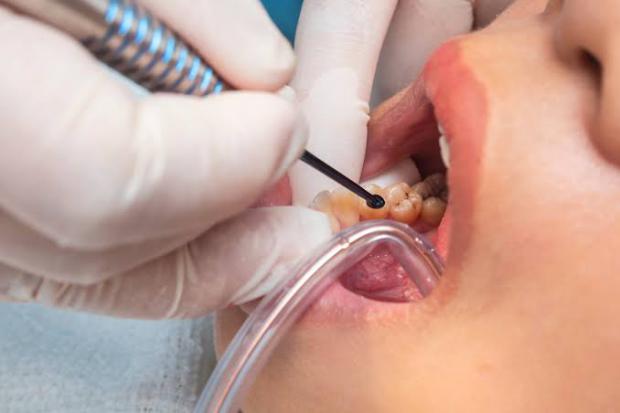
Now, a simple, inexpensive liquid called silver diamine fluoride (SDF) could spare many of those children. Applied to a cavity with a tiny sponge-tipped applicator in about a few second's time per tooth, SDF arrests decay without drilling, shots, or sedation.
Dentists have used SDF successfully for decades in many countries, and off label in the United States since 2014, when it was approved as a medical device to treat tooth sensitivity. However, it has lacked the large US population clinical trials for efficacy and safety that are needed for FDA approval as a drug to treat cavities.
Now, a University of Michigan-led clinical trial has produced that evidence.
Published in JAMA Pediatrics, the Phase III trial enrolled 830 children under age 6 who were recruited through dental offices, pediatric medical practices, and Head Start and Early Head Start programs in Michigan, New York, and Iowa.
Researchers found that SDF arrested tooth decay in more than half of children's affected baby teeth when treated at 6-month intervals. Unlike conventional treatment, which removes part of the tooth before placing a filling, SDF is simply painted onto the cavity.
"This is a very effective and safe treatment—even in children as young as 1," said Margherita Fontana, professor of dentistry at the University of Michigan School of Dentistry and the study's lead investigator.
Tooth decay is the most common chronic disease of childhood, affecting more than 40% of US children. Left untreated, cavities can cause severe pain, infection, difficulty eating and sleeping, missed school, and repeated medical visits.
SDF may be especially valuable for very young children, older adults, people with developmental or physical disabilities, patients with severe dental anxiety, and others who cannot easily tolerate or access conventional dental treatment, Fontana said.
Its primary drawback is cosmetic, she said. The silver permanently darkens the decayed portion of the tooth.
"If we want more children and families to benefit from this treatment, we need rigorous evidence showing both that it works and that it's safe. From a public health perspective, if we want broader implementation across the United States, including in medical settings, we need carefully collected data in US populations, and we now have that," Fontana said.