










Breaking News
 Brace Yourselves: Serious Trouble Brewing In The Data Center Industry
 Modular phone promises total privacy at the flick of a switch
 THE O'LEARY PLAN TO TAKE THOUSANDS OF ACRES FOR WATER RIGHTS.
 It's Starting: The Fall of Europe
Top Tech News
 Genetically Engineered War Dogs for 134 Pound Cyborg Dire Wolves Now – Later 600 Pound Wolves
 They're Quietly REPLACING Our Food With THIS… And Nobody Is Talking About It!
 Chicago Opens First "Teacher-Free" AI School as Global Push Accelerates
 Solar Panels Are Doing Something Nobody Expected
 DeLorean climbs skyward to race electric flying cars
 Atari's 800XL returns with a keyboard, cartridges and BASIC
 Bioinspired robot airdrops into remote waters via morphing wing-sail
 Anduril interceptor adapts to emerging threats via swappable stages
 I Built a Website to Expose Solar and Battery Scams
 Whistleblower Issues Dire Warning: Rogue AI, Hacking Nuclear Programs...



Revolutionary Desert Twins Can Produce Water Out Of Thin Air
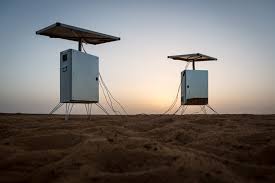
The SunGlacier device successfully captured water in the hottest, driest climate on Earth.
The SunGlacier device successfully captured water in the hottest, driest climate on Earth.
The innovative design team, SunGlacier, has created a device capable of capturing water even in the hottest, driest atmospheres. SunGlacier was invited by the Dutch Ministry of Defense to test the device. The Ministry selected a place in the Sahara Desert, located in the western Africa country, Mali.
SunGlacier named the device Desert Twins and said it is "probably the world's first artificial water well to work entirely off the grid." Desert Twins are named for the two units that work in tandem. One houses energy, while the other makes the water.
The device uses condensation to take water vapor from the air, like when water droplets appear on the surface of a cold glass. It is solar powered and uses a 12Volts, 50Watt system, which requires about as much energy as a standard car headlight.