










Breaking News
 10 Unexpected Consequences Of An Economic Crisis Nobody Is Talking About
 Trump says RAF Fairford terror suspects were 'looking to do big damage' to US forces as Iran
 Syria Opens Overland Fuel Transit Route To Iraq Amid Hormuz Closure
 New Jersey Microsoft-Linked Data Center Hit With Record Fine Over Unpermitted Gas Generators
Top Tech News
 Tesla Model 3 killer charges from 10 to 97% in just 9 minutes
 World-first unpowered DNA computer sets speed record
 I Power 5 Buildings Off-Grid. Here's How
 The US government is pushing hard to get a working nuclear fission reactor into space by late 2028
 SpaceX Starmind AI in Space Radiator
 China Will Dominate Global Nuclear Energy Through 2035, Analyst Says
 These Absolutely Wild-Looking EVs Are Saudi Arabia's First Homegrown Cars
 BEYOND THE MOON: NASA plans a nuclear-powered fleet to push DEEPER into space
 Big Oil Backs Mazama's $135 Million Bet On Superhot Geothermal
 Quantum compass takes flight on Northrop's Lumberjack drone


Xpoovv underwater housing fits a variety of smartphones
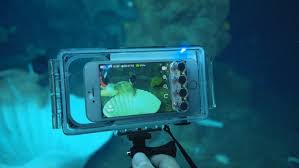
Made primarily of polycarbonate and stainless steel, the Xpoovv is reportedly compatible with any Apple or Android phone that has a screen size between 4.5 and 6.5 inches, and a maximum body size of 6.25 x 2.7 x 0.35 inches (159 x 69 x 9 mm).
The phone is placed in the lower right-hand corner of the housing, where four spring-loaded pushbuttons sit above its screen. When the user presses any of those buttons from outside the housing, their conductive silicone pads contact the screen, activating camera functions within the Xpoovv app. That app is also used to initially establish the make and model of phone, so that the onscreen camera controls line up with the buttons.
After the phone is sealed inside the Xpoovv, an included hand pump is used to draw the air out from inside of the housing. If the resulting vacuum is subsequently broken – allowing water to seep in – an air pressure sensor will detect it, triggering an integrated warning light to start flashing red.
The Xpoovv tips the scales at a claimed 360 grams (12.7 oz), and is rated to a maximum depth of 40 meters (130 ft). A screw mount on its exterior allows accessories such as lights or a handle to be added.