










Breaking News
 Facilitating Wholesale Digital Asset Settlement
 October 7th special with PROJECTPENS.org on Ben Swann's "America Now"
 Paris is on fire as rioters take over across France
 Trump Refuses Iran's Offer To Bail Out His Presidency
Top Tech News
 Bioinspired robot airdrops into remote waters via morphing wing-sail
 Anduril interceptor adapts to emerging threats via swappable stages
 I Built a Website to Expose Solar and Battery Scams
 Whistleblower Issues Dire Warning: Rogue AI, Hacking Nuclear Programs...
 Multi-material insulation delivers up to 10,000 x the stiffness
 Anduril's plan to save US sub edge from China's undersea surge
 Researchers Develop AI 'Mind-Reading' Tool That Reconstructs What Your Eyes See
 Video: Dexterous robot hand learns the delicate art of silk embroidery
 The computer that can read your mind:
  Seven apps. One craft


Disconnected: 2.9 Billion People Still Offline
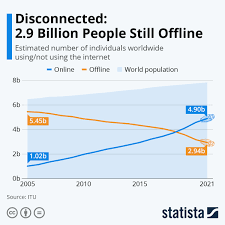
According to the latest estimates from the ITU, Statista's Felix Richter details below that 4.9 billion people now use the internet, up from 4.1 billion people in 2019.
This unusually sharp increase in internet users is attributed at least partly to what the ITU calls a "COVID connectivity boost".
"Widespread lockdowns and school closures, combined with people's need for access to news, government services, health updates, e-commerce and online banking" have driven the surge in internet usage according to the organization.
"While almost two-thirds of the world's population is now online, there is a lot more to do to get everyone connected to the Internet," ITU Secretary General Houlin Zhao said in a statement.