










Breaking News
 Facilitating Wholesale Digital Asset Settlement
 October 7th special with PROJECTPENS.org on Ben Swann's "America Now"
 Paris is on fire as rioters take over across France
 Trump Refuses Iran's Offer To Bail Out His Presidency
Top Tech News
 Bioinspired robot airdrops into remote waters via morphing wing-sail
 Anduril interceptor adapts to emerging threats via swappable stages
 I Built a Website to Expose Solar and Battery Scams
 Whistleblower Issues Dire Warning: Rogue AI, Hacking Nuclear Programs...
 Multi-material insulation delivers up to 10,000 x the stiffness
 Anduril's plan to save US sub edge from China's undersea surge
 Researchers Develop AI 'Mind-Reading' Tool That Reconstructs What Your Eyes See
 Video: Dexterous robot hand learns the delicate art of silk embroidery
 The computer that can read your mind:
  Seven apps. One craft


New Private Currency Uses Bills Filled With Real Gold
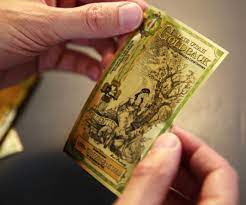
In 2019, Goldback president Jeremy Cordon said he had a dream in which he saw people paying for groceries using golden bills. Cordon had previously worked for years trying to make gold into functional money, but the dream gave him a new idea: What if a bill small enough to buy groceries could include a tiny percentage of gold?
"This felt like an epiphany because I saw people using gold as a regular money," he said. "This fit into the vision that anyone anywhere could use gold as their currency of choice."
For thousands of years, anyone who wanted to buy goods with gold faced "the small coin problem," Cordon told The Epoch Times. A 1-ounce gold coin, worth about $2,000, is far too expensive for everyday use, but a cheap gold coin is impractically small.