










Breaking News
 153 Nations Adopt UN Pandemic Declaration to Push FAST-TRACKED Vaccines Within 100 Days...
 Regarding the Claim That "Viruses Don't Exist!"
 The Fraud That Launched the mRNA Era
 U.S. Bankruptcy Filings Rise 11% in First Nine Months of 2026
Top Tech News
 Anduril's plan to save US sub edge from China's undersea surge
 Researchers Develop AI 'Mind-Reading' Tool That Reconstructs What Your Eyes See
 Video: Dexterous robot hand learns the delicate art of silk embroidery
 The computer that can read your mind:
 Seven apps. One craft
 SHOCK CASE REPORT: Advanced Alzheimer's Patient Regains Speech, Memory, Mobility...
 Most artificial limbs rely on silicone or plastic to mimic human hands.
 Flying cell tower beams phone signal to Japan from 10 miles up
 Chinese Commercial Reactor Achieves Nuclear Fusion with Clean Hydrogen-Boron Fuel
 Palmer Luckey: Autonomous Weapons Are Ancient and Why Anduril Won't Build Humanoids | EP #295



Vitamin C and Dandelion Root Killing Cancer Cells -- as Former CDC Director Calls for COVID-19...

Epidemiologist Nicolas Hulscher on Brannon Howse Live
Yesterday, I joined Brannon Howse Live to share some long-overdue good news. We discussed emerging breakthroughs in cancer research, the extraordinary promise of natural compounds like dandelion root and high-dose vitamin C, and a major development in the mRNA arena:
Dandelion Root Extract: A Common Weed With Anti-Cancer Power
·
Dec 9
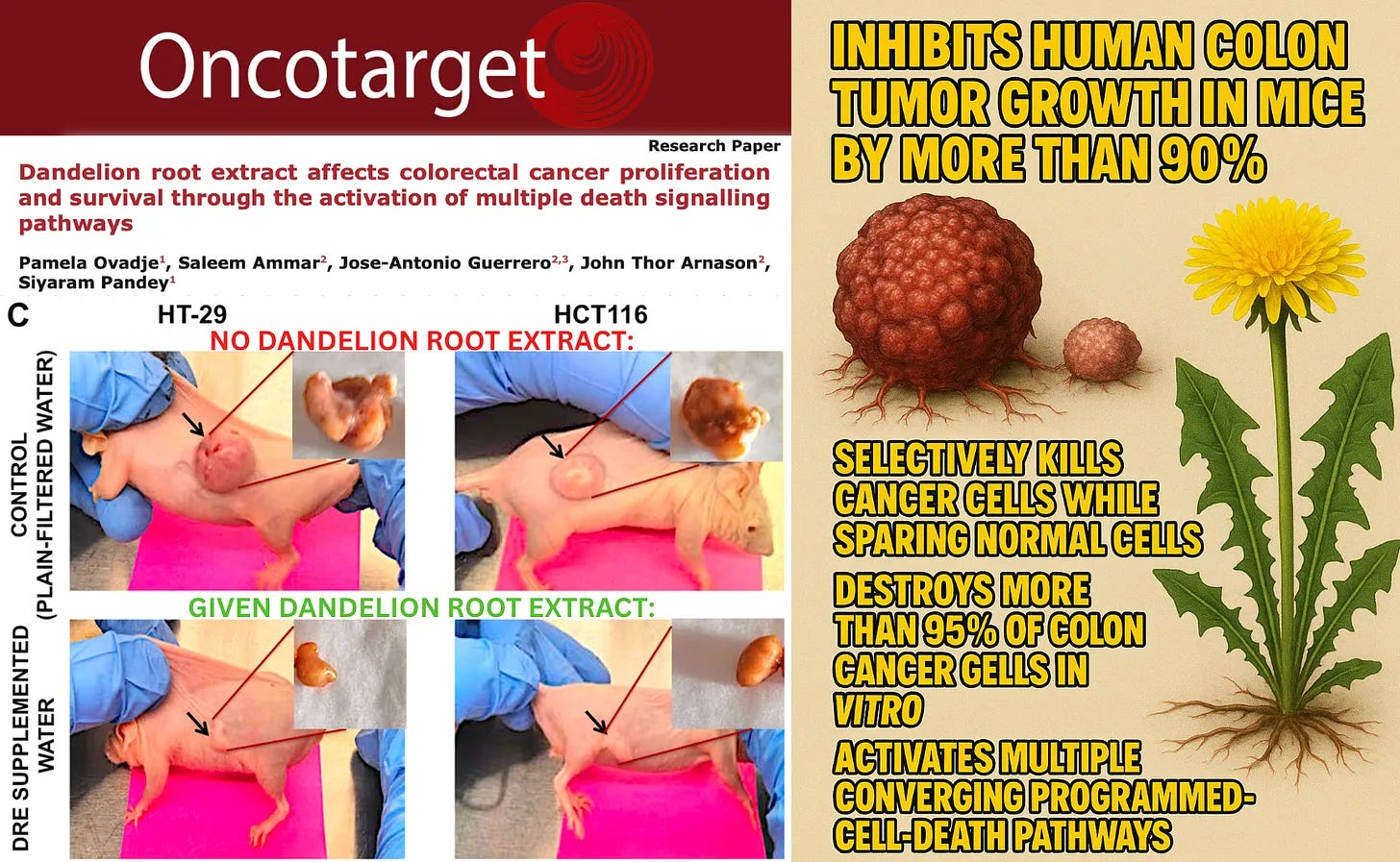
A remarkable peer-reviewed study found that aqueous dandelion root extract kills 95% of cancer cells in vitro and reduces human colon tumor growth by over 90% in mice — with zero toxicity.
Tumors in untreated mice grew aggressively.
Tumors in the treated group barely grew at all.
Human trials were planned but mysteriously never funded — likely because a common backyard plant is not profitable for the chemo-industrial complex.
This study fits into a larger body of over 1,100 peer-reviewed papers showing anti-cancer effects from natural, non-toxic compounds — an entire therapeutic frontier long ignored because it threatens the economics of conventional oncology.