










Breaking News
 153 Nations Adopt UN Pandemic Declaration to Push FAST-TRACKED Vaccines Within 100 Days...
 Regarding the Claim That "Viruses Don't Exist!"
 The Fraud That Launched the mRNA Era
 U.S. Bankruptcy Filings Rise 11% in First Nine Months of 2026
Top Tech News
 Anduril's plan to save US sub edge from China's undersea surge
 Researchers Develop AI 'Mind-Reading' Tool That Reconstructs What Your Eyes See
 Video: Dexterous robot hand learns the delicate art of silk embroidery
 The computer that can read your mind:
 Seven apps. One craft
 SHOCK CASE REPORT: Advanced Alzheimer's Patient Regains Speech, Memory, Mobility...
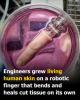 Most artificial limbs rely on silicone or plastic to mimic human hands.
 Flying cell tower beams phone signal to Japan from 10 miles up
 Chinese Commercial Reactor Achieves Nuclear Fusion with Clean Hydrogen-Boron Fuel
 Palmer Luckey: Autonomous Weapons Are Ancient and Why Anduril Won't Build Humanoids | EP #295



First-ever drug to repair DNA and regenerate damaged tissue is here

Researchers at Cedars-Sinai made the breakthrough after first developing a technique to isolate progenitor cells from the heart. These cells, much like stem cells, can form new healthy tissue but in a more targeted way. In other words, these cells taken from the heart can help restore function to that organ.
Medical scientist Eduardo Marbán – then at Johns Hopkins and now Cedars-Sinai – found that heart progenitor cells also have a special mechanism where they send out sacs, known as exosomes, which carry molecules of DNA, RNA and protein between cells and can repair and regenerate damaged tissue.
"Exosomes are like envelopes with important information," said first author Ahmed Ibrahim, PhD, MPH, an associate professor in the Department of Cardiology in the Smidt Heart Institute. "We wanted to take apart these coded messages and figure out which molecules were, themselves, therapeutic."
The team worked to unpack what was in those healing sacs, sequencing the exosomal RNA material and finally landeing on one molecule that was more prominent than others. Focusing on this one RNA molecule, animal studies confirmed the researchers' hypothesis that it played a key role in facilitating tissue repair.
Fast-forward two decades and the scientists have finally fabricated this naturally occurring RNA molecule in the lab – the synthetic healer known as TY1.
"By probing the mechanisms of stem cell therapy, we discovered a way to heal the body without using stem cells," said senior author Marbán, MD, PhD, executive director of the Smidt Heart Institute at Cedars-Sinai. "TY1 is the first exomer – a new class of drugs that address tissue damage in unexpected ways."
TY1 has the structure of existing RNA drugs, and works like its natural version – amplifying the activity of the Trex1 gene, which increases the activity of immune cells that rally around damaged DNA and clear out the junk, allowing for the repair and regeneration to take place. This process is critical in the wake of a heart attack to minimize cellular scarring left from the event.
Studies have demonstrated that DNA damage plays a critical role in the development of pressure overload–induced heart failure, dilated cardiomyopathy and aging-related cardiac conditions, and this damage to myocardial tissue is a large factor in how well someone recovers from a heart attack. Essentially, the less damage you have the better your long-term prognosis. Stimulating the cellular "recovery team," through this novel experimental drug, boosts the body's ability to repair itself.
And it doesn't stop at heart tissue damage repair.
"By enhancing DNA repair, we can heal tissue damage that occurs during a heart attack," Ibrahim said. "We are particularly excited because TY1 also works in other conditions, including autoimmune diseases that cause the body to mistakenly attack healthy tissue. This is an entirely new mechanism for tissue healing, opening up new options for a variety of disorders."
Following on from animal models, TY1 will next be studied in a clinical trial. If the drug performs as expected in humans, it paves the way for a new class of therapeutics that can help mitigate a broad range of cellular damage caused by both sudden adverse events and chronic inflammatory conditions.