










Breaking News
City by City Being Eaten Alive by Third World Immigration in America
 "Doomsday": U.S. Military Planning To Survive 90 Days Without Power Grid
 Former DOGE Staffers Hacked Into Anthropic's Internal Systems In 12 Hours...
 MASSIVE CRASH at the opening in Brazil
Top Tech News
 Modular phone promises total privacy at the flick of a switch
 Genetically Engineered War Dogs for 134 Pound Cyborg Dire Wolves Now – Later 600 Pound Wolves
 They're Quietly REPLACING Our Food With THIS… And Nobody Is Talking About It!
 Chicago Opens First "Teacher-Free" AI School as Global Push Accelerates
 Solar Panels Are Doing Something Nobody Expected
 DeLorean climbs skyward to race electric flying cars
 Atari's 800XL returns with a keyboard, cartridges and BASIC
 Bioinspired robot airdrops into remote waters via morphing wing-sail
 Anduril interceptor adapts to emerging threats via swappable stages
 I Built a Website to Expose Solar and Battery Scams


PulsarFusion a forward-thinking UK aerospace company, is pushing the boundaries of space travel...
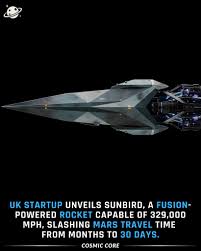
Powered by a Direct Fusion Drive (DFD), Sunbird draws inspiration from the same energy source that fuels the Sun offering clean, efficient, and extraordinarily powerful propulsion unlike anything used in current spacecraft. Its projected top speed of 329,000 mph marks a dramatic leap in propulsion capability.
If successful, Sunbird could completely rewrite interplanetary travel timelines. A journey to Mars, which normally takes around seven months with today's chemical rockets, could be reduced to just 30 days. Such a breakthrough wouldn't only accelerate human missions it would also transform cargo transport, asteroid mining, and deep-space exploration by making long-distance travel faster, safer, and more sustainable.
Despite its cutting-edge technology, Sunbird is designed with reuse, efficiency, and practicality in mind. Each rocket is expected to cost roughly $70 million, positioning it as a powerful yet cost-effective alternative for future space missions. Its fusion design produces minimal waste and relies on reactions that release massive energy without relying on fossil fuels or conventional combustion.
Pulsar Fusion plans to take Sunbird into space for testing by 2027, marking what could be the first major step toward real fusion-powered spacecraft something long imagined but never achieved.