










Breaking News
 The Middle East Security Map Is CHANGING FAST! Saudi Arabia, Pakistan & Turkey Move Toward...
 Report: US Troops and Diplomats Evacuating Posts Across the Middle East
 The USDA's $8 Billion Farmer Bailout Is Communism Disguised as Relief
 Sell The Bailout: Skydance Tumbles As Musk's $1 Billion Check Reminds Everyone Paramount...
Top Tech News
 Chicago Opens First "Teacher-Free" AI School as Global Push Accelerates
 Solar Panels Are Doing Something Nobody Expected
 DeLorean climbs skyward to race electric flying cars
 Atari's 800XL returns with a keyboard, cartridges and BASIC
 Bioinspired robot airdrops into remote waters via morphing wing-sail
 Anduril interceptor adapts to emerging threats via swappable stages
 I Built a Website to Expose Solar and Battery Scams
 Whistleblower Issues Dire Warning: Rogue AI, Hacking Nuclear Programs...
 Multi-material insulation delivers up to 10,000 x the stiffness
 Anduril's plan to save US sub edge from China's undersea surge



Nano-magnets may defeat bone cancer and help you heal
It turns out that Magneto really should have studied oncology, because if he had, he might have learned that magnetism could be an ultimate weapon against cancer. And then, instead of waging war on humanity, all nations would bow before him, the trillionaire controlling the medical establishment (that is, a different sort of supervillain).
That's probably not what a team of researchers from Brazil and Portugal were thinking when they harnessed magnetic nanomaterials to find a way to stop bone cancer and heal the body in its wake, but it still holds.
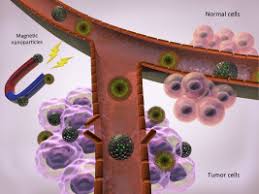
ngela Andrade, corresponding author of the Magnetic Medicine paper "Magnetic core-shell nanocomposites with bioactive glass coatings for hyperthermia-assisted bone cancer therapy," explains how magnetic bioactive nanocomposites offer so much promise in defeating bone cancer. They simultaneously eliminate tumors through magnetic hyperthermia – essentially, burning cancer cells from the inside – while supporting new bone growth. Using this method allows "high magnetization of the nanocomposite and a strong bioactivity in the same material, which has been a long-standing challenge in this field."
How does the process work? Andrade and her team synthesized and coated iron oxide magnetic nanoparticles with bioactive glass. During exposure to simulated bodily fluids, these magnetic bioactive nanocomposites quickly formed a group of phosphate minerals called apatites which are similar to the nonorganic material in bone, allowing them easy integration into bone.
"Among the tested formulations," says Dr. Andrade, from the Department of Chemistry at the Universidade Federal de Ouro Preto (UFOP) in Brazil, "the one with a higher calcium content demonstrated the fastest mineralization rate and the strongest magnetic response, making it an ideal candidate for biomedical applications."
Because the bioactive nanocomposites are magnetic, oncologists can employ magnetic hyperthermia – that is, the application of an alternating magnetic field to heat the particles inside cancer cells and destroy them. Because the nanoparticles don't enter healthy cells, those cells remain unharmed. Then, thanks to their bioactive glass coating, the particles help regenerate tissue. In the fight against bone cancer, they're not simply search-and-destroy, but search, destroy, and repair.