










Breaking News
 Technocracy Remembered: The Shape Of A Continental Imagination
 Rand Paul just revealed he's working with RFK Jr. to prosecute Fauci. But Trump's DOJ is ign
 BREAKING EXCLUSIVE: "I Think Bill Gates Is The Boss," Epstein Survivor Claims Gates Was...
 Musk Offers Free Starlink As Iran Protests Endure Internet, Comms Blackout
Top Tech News
 Superheat Unveils the H1: A Revolutionary Bitcoin-Mining Water Heater at CES 2026
 World's most powerful hypergravity machine is 1,900X stronger than Earth
 New battery idea gets lots of power out of unusual sulfur chemistry
 Anti-Aging Drug Regrows Knee Cartilage in Major Breakthrough That Could End Knee Replacements
 Scientists say recent advances in Quantum Entanglement...
 Solid-State Batteries Are In 'Trailblazer' Mode. What's Holding Them Up?
 US Farmers Began Using Chemical Fertilizer After WW2. Comfrey Is a Natural Super Fertilizer
 Kawasaki's four-legged robot-horse vehicle is going into production
 The First Production All-Solid-State Battery Is Here, And It Promises 5-Minute Charging
 Storage doesn't get much cheaper than this


South Korea Seeks Death Penalty For Ex-President Yoon's Botched Martial Law Attempt
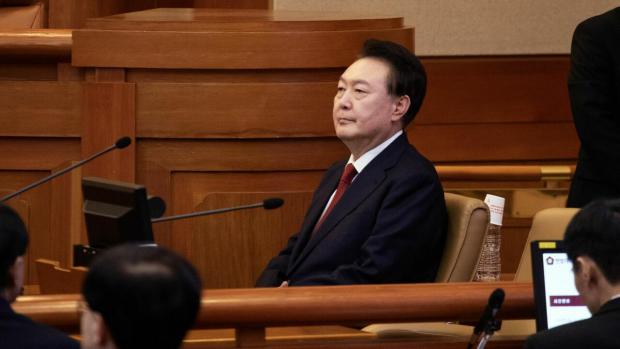
Closing arguments have been made in his trial in a Seoul court as he stands accused of being the "ringleader of an insurrection".
Yoon's botched attempt in December 2024 to impose martial law in South Korea lasted a mere hours but plunged the country into political turmoil and chaos. He was soon after impeached from office by parliament and was arrested pending trial.
Seeking the death penalty seems ultra-harsh, but it's actually in keeping with South Korean criminal code, under which leading a rebellion carries three possible penalties: capital punishment, life imprisonment with hard labor, or life imprisonment without compulsory labor.
Prosecutors allege that he ordered military and police forces to seal off the National Assembly in an effort to prevent lawmakers from entering the building where they would overturn the martial law decree.
Importantly, South Korea has not carried out an execution since 1997 - so if Yoon is eventually executed (though would likely be some kind of drawn out appeals process), it would send a chilling and strong message to current and future leaders.
In 1996, ex-President Chun Doo-hwan, who ruled from 1980 to 1988, was sentenced to death for rebellion, high treason, and corruption stemming from his role in the 1979 military coup and the violent suppression of the Gwangju uprising in 1980.
His sentence was later commuted to life imprisonment by appellate courts, including the Supreme Court. He was ultimately pardoned in 1997 by then-President Kim Young-sam as part of a 'national reconciliation' initiative.
And in the years running into the 2010s there was this litany:
Chun's successor, Roh Tae-woo, was also tried in 1996 on charges of rebellion and corruption. He initially received a 22-year prison sentence, which was later reduced to 17 and a half years. Like Chun, Roh was pardoned in 1997.
Former President Lee Myung-bak, who served from 2008 to 2013, was convicted of corruption and abuse of power and sentenced to 15 years in prison. He was later pardoned in 2022 by President Yoon Suk-yeol.
President Park Geun-hye, who held office from 2013 to 2017, was impeached, as was Yoon Suk-yeol. In 2018, she received a 24-year prison sentence on corruption charges, before being pardoned in 2021 by President Moon Jae-in.