










Breaking News
Great Replacement, Fragmenting America, Disaster Zone, Minneapolis
 Trump Says US 'Starting to Talk to Cuba'
 Explosive update on anonymous 2019 4Chan post claiming Epstein was 'switched out'…
 Does Trump's appointment of Kevin Warsh Signal an approaching financial crisis?
Top Tech News
 How underwater 3D printing could soon transform maritime construction
 Smart soldering iron packs a camera to show you what you're doing
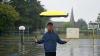 Look, no hands: Flying umbrella follows user through the rain
 Critical Linux Warning: 800,000 Devices Are EXPOSED
 'Brave New World': IVF Company's Eugenics Tool Lets Couples Pick 'Best' Baby, Di
 The smartphone just fired a warning shot at the camera industry.
 A revolutionary breakthrough in dental science is changing how we fight tooth decay
 Docan Energy "Panda": 32kWh for $2,530!
 Rugged phone with multi-day battery life doubles as a 1080p projector
 4 Sisters Invent Electric Tractor with Mom and Dad and it's Selling in 5 Countries



Look, no hands: Flying umbrella follows user through the rain
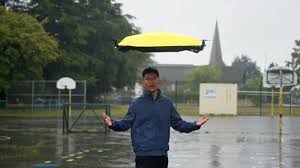
And a strong gust of wind can often throw a wrench into the whole thing. So the idea of an umbrella that simply hovers above you feels instantly appealing: no handling required.
That's the hook behind a flying umbrella built by YouTuber and maker John Xu of the I Build Stuff channel. He first built a drone-powered umbrella back in 2024, and it was, without question, an awesome feat. However, viewers were quick to point out the obvious flaw: it needed to be flown by a handheld controller. The comments were blunt: impressive, but impractical.
Xu took these comments to heart and spent the last two years working on a flying umbrella that did indeed follow him. And the result is definitely something to behold.
His first flying umbrella was unapologetically experimental. A self-built X-armed quadcopter powered the umbrella's flight, creating a sci-fi-like image of rain protection from above. It was equal parts clever and absurd – and it made its point. As a proof of concept, it showed that overhead rain cover was indeed possible.
The downside was obvious, though: the umbrella had to be manually controlled. Rather than freeing up your hands, it required you to use both hands and added another device to manage. Viewers on YouTube were quick to call it out, with many echoing the same sentiment: "Now make it follow you."
This feedback was the basis of Xu's redesign, which he first started later in 2024. He set out to make the umbrella autonomous, finding that it took a few false starts to realize his vision. GPS tracking proved too coarse, with accuracy drifting by a few meters. And the fact he wanted to make the umbrella (and the drone at its heart) foldable added another layer of mechanical complexity.
The breakthrough came with a time-of-flight camera, which allowed the flying umbrella to track and follow a user directly, even in the dark. The umbrella wasn't perfect: it didn't stay perfectly overhead at all times, but worked well enough to completely transform the project. What started off as a striving novelty turned into something genuinely useful, and YouTube viewers took notice.
Of course, a flying umbrella raises just as many questions as it answers. Wind and heavy rain can easily push a lightweight drone off balance, and its battery life limits how long it can stay aloft above you. There's also the noise issue, and the somewhat awkward reality of spinning rotors whirring dangerously above people in public places.