










Breaking News
 Rising Prices and Falling Values--Inflation and Social Decay
 The non-Zionist Israeli Population Could Save the Day
 AfD Launches 'Knife App' As Berlin Violence Surges
 Oil Prices EXPLODE After Trump Signals That US Is Moving To Wartime Economy
Top Tech News
 DARPA O-Circuit program wants drones that can smell danger...
 Practical Smell-O-Vision could soon be coming to a VR headset near you
 ICYMI - RAI introduces its new prototype "Roadrunner," a 33 lb bipedal wheeled robot.
 Pulsar Fusion Ignites Plasma in Nuclear Rocket Test
 Details of the NASA Moonbase Plans Include a Fifteen Ton Lunar Rover
 THIS is the Biggest Thing Since CGI
 BACK TO THE MOON: Crewed Lunar Mission Artemis II Confirmed for Wednesday...
 The Secret Spy Tech Inside Every Credit Card
 Red light therapy boosts retinal health in early macular degeneration
 Hydrogen-powered business jet edges closer to certification


Nuclear Reactor Transported By Air For First Time In 60 Years
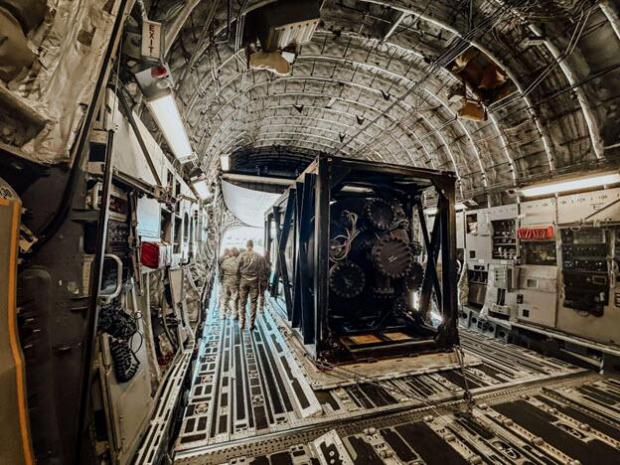
The event marks a major turning point for the nuclear industry, as reactor developers had been seen until this point as just another group of boring construction teams and quiet operators. But the more glamorous side of venture capital funded efforts is starting to make its way into the world of fission.
Nuclear energy has suffered from decades of neglect and atrophy, and it appears the newest generation of venture capitalists and entrepreneurs are finally taking interest in the nuclear industry again.
Coverage of the event has been provided by all the major outlets including Reuters and Wall Street Journal, but there is a lack of understanding for what's actually going on. None of the news agencies reporting on the event have provided any added context to the history of reactors up in the air, what Valar Atomics is trying to do, and frankly what was even inside the plane.
Valar constructed their Ward250 gas reactor in their facility in California. There is no fuel added to the reactor core yet, as shipping that through the air would be a regulatory nightmare in today's environment. To put out the fires of some of the fear-mongering that has been going around about the event, which will come off as underplaying the advanced engineering and fabrication that went into the production of the components, all Valar did was ship a complicated piece of metal in a cargo plane.
To be sure, the company has made significant progress toward meeting the July 4th criticality timeline set by last year's nuclear executive orders. Taking a reactor critical means the reactor goes from a dormant, shutdown state to the point where the uranium inside the core is undergoing a sustained, controlled rate of fission (atoms splitting apart and releasing energy) on its own.
And this latest milestone with government agencies was a phenomenal exercise in complicated logistical coordination, private-public partnerships, and capability demonstrations.
One of the biggest errors in most of the reporting is that this is the first time a reactor has been put up into the sky. This can unfortunately not be further from the truth, even though Secretary Wright tries to make the same claim.
Scrolling all the way back to the 1950s, as the world was proving nuclear energy could be used for other than weaponry and destruction, President Eisenhower's Atoms for Peace initiative sent a nuclear reactor across the Atlantic to Geneva, Switzerland. It was a pool-type research reactor built and tested in Tennessee. The reactor was dismantled and flown to Geneva where it was rebuilt and taken critical again.
Also in the 1950s, the U.S. pursued nuclear-powered long-range bombers before cruise missiles were developed. The Aircraft Nuclear Propulsion Program developed the Aircraft Shield Test Reactor and flew it in the air with fuel while operating under a multi-year test program. The reactor was never used to directly power an aircraft and the program was eventually shut down.