










Breaking News
 The US Military Is Involved In A Massive Mobilization Of Infantry Troops To Launch A FULL SCALE...
 Iran Is Not My Enemy
 Scientists reveal controversial plan to launch 50,000 MIRRORS into space for 'sunlight on demand
 Controversial geoengineering project sees scientists pump 65,000 litres of chemicals into...
Top Tech News
 The Pentagon is looking for the SpaceX of the ocean.
 Major milestone by 3D printing an artificial cornea using a specialized "bioink"...
 Scientists at Rice University have developed an exciting new two-dimensional carbon material...
 Footage recorded by hashtag#Meta's AI smart glasses is sent to offshore contractors...
 ELON MUSK: "With something like Neuralink… we effectively become maybe one with the AI."
 DARPA Launches New Program Generative Optogenetics, GO,...
 Anthropic Outpaces OpenAI Revenue 10X, Pentagon vs. Dario, Agents Rent Humans | #234
 Ordering a Tiny House from China, what's the real COST?
 New video may offer glimpse of secret F-47 fighter
 Donut Lab's Solid-State Battery Charges Fast. But Experts Still Have Questions



War On Iran – Oil Prices Lag Supply Deficit – Arab's Won't Fight Iran – Khamenei Son Succe
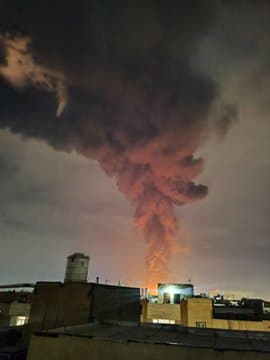
Iraq has shut down some oil wells. As have Kuwait, Qatar, Bahrain, the Emirates and Saudi Arabia.
Qatar has also shut down is gas wells and the process 'trains' needed to liquefy natural gas.
All this because of the virtual closure of the Strait of Hormuz and because of potential missile and drone attacks on the fragile production installations.
While oil and LPG prices have increased the global markets have not yet recognized the length and severity of the supply crunch these shut downs will cause. Prices, currently in the high $90/bl, will need to get much higher ($150+/bl) to cause an equivalent demand destruction.
Even if the war on Iran would stop tomorrow and if the Strait would reopen immediately it would take many weeks until the supplies would be back to normal levels.
Oil wells, once shut down, often require rework to open them up again. The bore of an unused the well may close up, sediments may block the oil flow, valves start to fail. It means that drilling rigs will need to be setup at each of the wells with days of rework needed to re-establish its outflow. There are thousands of wells that have been shut down.
Qatar's liquefaction of natural gas is a special problem as the process to create Liquefied Petroleum Gas is quite complex:
The first step on the onshore facilities is the separation of condensate from gas. The separated condensate is stabilised and sent to storage to await export. The natural gas then flows to the liquefaction trains for processing into LNG. During the first phase of this process, sulphur compounds, carbon dioxide, and water are removed in stages. The gas is then chilled using propane and ?mixed refrigeration processes.
The heavy hydrocarbons are separated out and fractionated into liquefied petroleum gas (LPG) and plant condensate. The cryogenic main heat exchanger in each train then cools the gas to approximately – 150 °C, liquefying it in the process. Finally, as the pressure is reduced to almost zero, the temperature decreases to – 162 °C, nitrogen is removed and LNG is transferred to one of the storage tanks prior to being loaded into a LNG vessel.???
When a liquefaction train shuts down all the product in it will have to be removed. The whole cryogenic chain, once stopped, will warm up and will need to be cooled down again to its very low working temperatures. The metal structures involved do not react well, to say it mildly, to warming up and cooling down cycles. Failures will occur. Repairs will be needed.
It will take at least two months to revive the Qatari process trains. This of course only after the war has ended. Some 20% of the global LPG supply will thus be unavailable for a lengthy period of time.
The Arab Gulf states are miffed that Iran is targeting their countries. But it is them who allow the U.S. to use their sovereign space to attack Iran. Empty ATAMCS containers were found in the desert of Kuwait and Bahrain. The missiles were used by U.S. troops using HIMARS launchers to fire towards Iran. A recent failure by a U.S. bomber pilot to shut off his air transponder showed that Saudi airspace was used to refuel U.S. bombers for attacks in Iran.