










Breaking News
 Iran War Hits Cyber, Food, Energy: Stryker Cyberattack, India Fertilizer Stoppage
 Now Its Time to PANIC
 Cork Stryker plants hit by suspected global Iranian-linked cyberattack
270 WSM Ballistics From Major Manufacturers
Top Tech News
 Human Brain Cells Merge With Silica To Play DOOM
 Will Yann LeCun Provide The Next Breakthrough In AI?
 Human Brain Cells Merge With Silica To Play DOOM
 Solar And Storage Could Reshape Rural Electricity Markets
 With World Seemingly At War, DARPA Finds Time To Unveil The X-76
 Renewable Water From Air.
 The world's first diesel plug-in hybrid pickup truck is here
 US advances nuclear revival with approval of Natrium Gen IV reactor
 Your Contractor Doesn't Want Me To Show You This!
 CEO of Blacklisted AI Company Anthropic, Dario Amodei Says His AI Models 'May Have Gained...



Fake Elon Musk Post Claiming Tesla Will Stop War Draft Dodgers Goes Viral
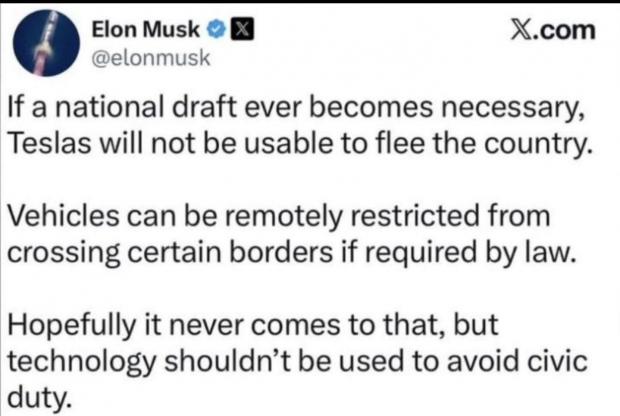
The image, which appears to mimic a post from Musk's X account, states that Tesla cars could be "remotely restricted from crossing certain borders if required by law" and suggests the technology should not be used to avoid "civic duty."
There is no record of Musk posting the statement, but that has not stopped the post from gaining viral attention from people questioning what was supposedly written.
Newsweek reached out to Tesla via email for comment.
Why It Matters
Tesla has repeatedly faced viral misinformation about its inner workings, from being forced to deny it would swap Bitcoin for cars, to confirming that it cannot remotely disable vehicles.
What To Know
The post has been shared thousands of times across Threads and other platforms, with some users citing it as evidence that Tesla could be used as a tool of government enforcement.
The fake X post read in full: "If a national draft ever becomes necessary, Teslas will not be usable to flee the country. Vehicles can be remotely restricted from crossing certain borders if required by law. Hopefully it never comes to that, but technology shouldn't be used to avoid civic duty."
While the post looks like it came from Musk's official X account, there is no evidence that it was ever posted.
Further to this, according to Tesla's official owner manuals, the company can communicate with vehicles remotely for specific, limited purposes, including software updates, diagnostics and owner?initiated features accessed through the company cellphone app.
The manuals confirm that Tesla vehicles receive over?the?air software updates and can connect to company servers for functions such as navigation data, charging information and safety alerts.
Owners can also remotely lock or unlock their vehicles, control climate settings and locate their car using the Tesla app, provided mobile access is enabled.
However, Tesla has publicly stated in past responses to viral claims that it does not have the capability to remotely shut down a moving vehicle. The company has said that disabling a car while in motion would pose a serious safety risk and is not how its systems are designed to operate.
Tesla's documentation also does not describe any mechanism that would allow the company to prevent vehicles from crossing national borders or to selectively restrict travel based on government policy or military service requirements.