










Breaking News
 Alex Jones Live: Zelensky Goes To War With Trump, Launches Biggest Attack Yet On Russian...
 Dr. Oz Reveals What's Really Making Americans Sick...- SF764
 Pentagon Confirms Hasan Execution To Be Hosted By Ryan Seacrest
 The Surprise Issue that May Swing Ohio and Michigan Is Data Centers
Top Tech News
 Anduril's plan to save US sub edge from China's undersea surge
 Researchers Develop AI 'Mind-Reading' Tool That Reconstructs What Your Eyes See
 Video: Dexterous robot hand learns the delicate art of silk embroidery
 The computer that can read your mind:
 Seven apps. One craft
 SHOCK CASE REPORT: Advanced Alzheimer's Patient Regains Speech, Memory, Mobility...
 Most artificial limbs rely on silicone or plastic to mimic human hands.
 Flying cell tower beams phone signal to Japan from 10 miles up
 Chinese Commercial Reactor Achieves Nuclear Fusion with Clean Hydrogen-Boron Fuel
 Palmer Luckey: Autonomous Weapons Are Ancient and Why Anduril Won't Build Humanoids | EP #295



Nearly Half of Cancer Patients Taking Ivermectin + Mebendazole...
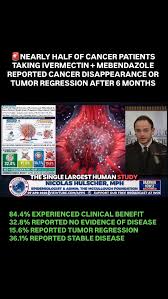
Epidemiologist Nicholas Hulscher reported that in the largest study of Ivermectin and Mebendazole anti-parasitic treatments, nearly half of the patients in the study reported a disappearance of the cancer or tumor regression. He wrote that 32.8% of the study participants showed no more evidence of disease after 6 months, 15.6% reported tumor regression and 36.1% reported that the disease had stabilized and was no longer spreading.
The clinical program evaluation included 197 cancer patients, with 122 completing a follow-up survey at about six months (61.9% response rate).
The cancer patients were prescribed compounded ivermectin–mebendazole, with each capsule containing 25 mg ivermectin and 250 mg mebendazole—most commonly taken at 1–2 capsules per day.
NOTE: The Need To Know News does not endorse any medical treatments, but instead reports the news. Please consult your own medical health experts before engaging in any medical treatments.
Report from epidemiologist Nicholas Hulscher:
????NEARLY HALF OF CANCER PATIENTS TAKING IVERMECTIN + MEBENDAZOLE REPORTED CANCER DISAPPEARANCE OR TUMOR REGRESSION AFTER 6 MONTHS
— Nicolas Hulscher, MPH (@NicHulscher) April 8, 2026
84.4% EXPERIENCED CLINICAL BENEFIT
32.8% REPORTED NO EVIDENCE OF DISEASE
15.6% REPORTED TUMOR REGRESSION
36.1% REPORTED STABLE DISEASE
Our study… https://t.co/QfY65HxQgM pic.twitter.com/n8eRPBa0ce